
What to Consider When Choosing Finger Support Sleeves
Different finger support sleeves can vary in material, thickness, elasticity, coverage, fit, flexibility, edge construction, and intended use. This guide breaks down every factor that actually matters so you can make a more informed comparison — without getting lost in marketing language or guessing at what “support” really means.
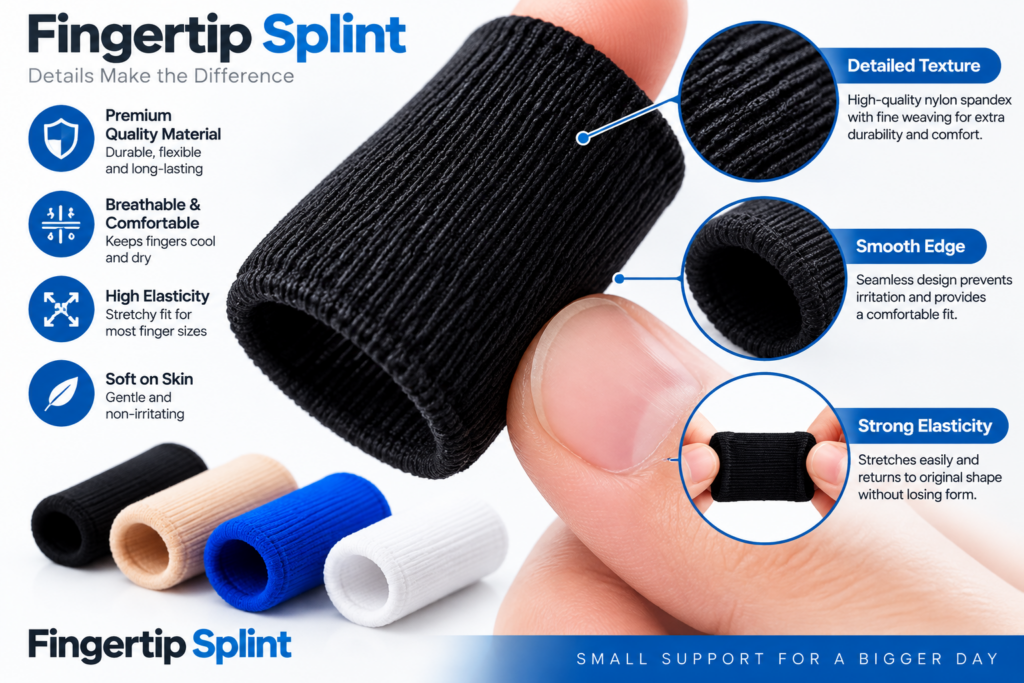
What This Guide Covers
- Quick Answer
- The 10-Point Framework
- Start With Purpose
- Finger & Coverage
- Size & Measurement
- Fit: Loose vs Tight vs Appropriate
- Material Characteristics
- Flexibility & Movement
- Coverage vs Mobility
- Comfort Factors
- Thickness & Profile
- Daily Activities
- What “Support” Actually Means
- Construction & Quality
- Adjustability
- Ease of Use
- Maintenance & Durability
- Price Considerations
- Common Buying Mistakes
- Priority Wheel
- Build Your Ideal Sleeve
- Product Spotlight
- When a Sleeve Isn’t Right
- FAQ
Quick Answer: What Should I Consider?
When choosing a finger support sleeve, consider the intended use, correct sizing, finger coverage, material, flexibility, comfort, thickness, and how the sleeve will interact with your daily activities. A suitable sleeve should match the user’s practical requirements rather than simply providing the greatest amount of compression or restriction.
That’s the short version. But most buyers need more than a checklist — they need to understand why each factor matters and how to evaluate it. If you’re still getting familiar with the broader world of finger support products, the finger support products collection at FingertipSplint offers a useful starting point. Below, we’ll walk through the full framework step by step.
The 10-Point Selection Framework
This is the core structure of this buying guide. Every decision you make about a finger sleeve comes down to these ten factors. Not all ten are equally important for every buyer — but all ten influence whether the sleeve actually works for you.
What do you actually need the sleeve to do?
Which finger and which area needs coverage?
Correct measurements based on manufacturer guidance.
Snug, secure, and appropriately positioned.
Stretch, recovery, softness, and durability.
How much movement do you need preserved?
What type of support does the product actually provide?
Comfort during movement, not just at rest.
How the sleeve interacts with your daily tasks.
Construction, durability, and maintenance.
1. Start With Your Reason for Choosing a Sleeve
Before you look at any product, ask one question: what do I actually need the sleeve for? Different purposes lead to different priorities, and a sleeve that works well for one may not match another.
Common Priorities
- Everyday flexible support
- Coverage of a specific area
- Comfort during long wear
- Low-profile use during work or study
- Activity-related support
- General finger support during routine tasks
What Purpose Determines
- Which features matter most
- What coverage is appropriate
- How flexible the sleeve should be
- How much bulk is acceptable
- How long you’ll wear it
- What material characteristics are important
Important: This guide isn’t a substitute for diagnosing an injury. If you have a specific medical concern, professional assessment matters more than product selection. For a practical look at how sleeves fit into everyday life, see How Finger Sleeves Provide Everyday Finger Support and Comfort.
2. Consider Which Finger and Area Need Coverage
Not all finger requirements are identical. The finger you need to support, and the specific area that needs coverage, both influence which sleeve design is appropriate.
Interactive: Coverage Zones
Tap each zone to see what to consider
👆 Fingertip Coverage
Covers only the end of the finger. Useful for precision tasks or protection during contact-heavy activities. Preserves maximum dexterity for fine motor tasks.
Coverage should match the area you actually need supported or protected. More coverage isn’t automatically better.
Coverage affects fit, mobility, comfort, sleeve stability, and how the sleeve interacts with daily activities. If you want a deeper look at coverage selection, see Finger Sleeves for Support: A Guide to Fit, Comfort and Coverage.
3. Size and Measurement
Getting the right size is the single most important practical step. A correctly sized sleeve provides consistent coverage, stays in position, and feels comfortable. A wrongly sized sleeve — even one made from premium material — won’t do its job well.
Common Measurements
- Finger circumference
- Finger length
- Finger width (in some systems)
What Matters
- Follow the specific manufacturer’s system — they vary
- Measure the exact area the sleeve will cover
- Don’t assume size labels mean the same across brands
- Consider whether coverage is partial or extended
Important: There’s no universal finger sleeve measurement system. Each manufacturer uses their own sizing. Always follow the specific product’s instructions rather than applying a generic method.
4. Fit: Too Loose vs Too Tight vs Appropriate
Fit determines whether the sleeve does its job. Here’s the practical comparison:
❌ Too Loose
- Sliding during movement
- Bunching
- Inconsistent coverage
- Distraction during activities
✅ Appropriate Fit
- Stays in place
- Doesn’t create unnecessary pressure
- Allows intended movement
- Provides consistent coverage
❌ Too Tight
- Excessive pressure
- Discomfort
- Numbness or tingling
- Discoloration
If you experience numbness, tingling, or discoloration, remove the sleeve and reassess. Persistent symptoms warrant professional advice. For a full comfort-focused guide, see How to Choose a Comfortable Finger Sleeve for Support.
5. Material: What Should You Look For?
Material affects feel, movement, durability, and comfort. Rather than memorizing material names, understand the characteristics that matter.
↔️ Stretch
How much the material conforms to finger shape.
🔁 Elastic Recovery
Whether it returns to shape after stretching.
🌟 Texture
How the surface feels against skin.
📦 Thickness
Bulk versus dexterity.
☁️ Skin Contact
Softness against sensitive areas.
💧 Moisture Handling
How it manages sweat during wear.
🛡️ Durability
How it holds up over repeated use.
🔄 Flexibility
How easily it moves with the finger.
The same material can perform differently depending on thickness, weave or construction, elasticity, stitching, and sleeve shape. For a deeper look at construction, see Finger Support Sleeves Explained: Features, Uses and Design.
6. Flexibility and Movement
Flexibility is one of the most important factors for everyday use. Ask yourself: how much movement do you need during your normal activities?
A flexible design may be more suitable for activities where finger movement remains important. But if a healthcare professional has specifically recommended movement restriction or immobilization, follow that guidance — don’t choose a product based solely on flexibility preference. For the comparison side, see Finger Support Sleeve vs Finger Splint: What’s the Difference?
7. Coverage vs Mobility
Increased coverage can change mobility, bulk, comfort, interaction with objects, and overall feel. But it’s not a simple equation — the relationship depends on the sleeve’s construction and the area covered.
Minimal Coverage
Less bulk, more dexterity. Useful for typing, writing, and precision tasks. Less overall protection or support.
Extended Coverage
More of the finger is supported. Can feel more noticeable. Useful when support needs span a broader area.
Match coverage to the area that actually needs it. More coverage isn’t automatically better — it can add bulk and reduce natural movement.
8. Comfort Factors
Comfort isn’t one thing. It’s several factors working together. Here’s what to evaluate:
🧵 Material
Does it feel suitable against the skin?
📏 Fit
Does it stay in place without excessive pressure?
📦 Thickness
Does it add unnecessary bulk?
✂️ Edges
Do the edges sit comfortably?
🔄 Movement
Does the sleeve interfere with normal activities?
⏳ Duration
How does it feel during the intended period of use?
For a full comfort-focused guide, see the articles linked above in the fit and comfort sections.
9. Thickness and Profile
Thickness is a trade-off, not a quality marker. Here’s how to think about it:
Low-Profile Designs
May be useful when typing, writing, using a smartphone, handling documents, or performing desk activities. Preserve dexterity.
Thicker Designs
May feel more substantial and add bulk. Interact differently with grips and objects. Trade-off: less dexterity, more cushioning.
Neither is universally better. The appropriate thickness depends on the design and your intended use.
10. Consider Your Daily Activities
What you do with your hands shapes what matters most. Tap each activity to see the specific priorities.
Interactive: Activity Priorities
Tap each activity to see what to prioritize
TYPING
Repeated movement
WRITING
Grip & control
SMARTPHONE
Tapping & swiping
STUDYING
Extended use
OFFICE WORK
Keyboard & mouse
TRAVEL
Portability
Typing
Prioritize flexibility, low profile, and secure fit. A thick or loose sleeve can interfere with typing rhythm and accuracy. A thin, well-fitted sleeve designed for everyday use is usually a better match for keyboard work.
For a deeper activity-by-activity guide, see Understanding Finger Support Sleeves for Everyday Activities.
11. Support Level: What Does “Support” Actually Mean?
“Support” is one of the most overused words in this category. It can mean very different things depending on the product. Here’s what it might actually refer to:
The sleeve surrounds a portion of the finger — providing a physical layer around the covered area.
Gentle, consistent pressure around the finger — if the product is designed for it.
Consistent positioning during movement — the sleeve stays where you put it.
Maintaining a specific finger position — more relevant for structured supports.
Limiting certain movements — usually a function of structured designs, not flexible sleeves.
The subjective sense that the finger is supported and covered during use.
Careful wording: Vague phrases like “maximum support” don’t tell you what type of support a product actually provides. Ask specifically: what does this sleeve do? Coverage? Compression? Stability? The answer tells you whether it matches your need.
12. Construction and Quality
Beyond marketing language, here’s what to inspect in a sleeve:
🧶 Stitching
🧵 Seams
✂️ Edges
↔️ Elasticity
🧵 Material consistency
🏗️ Construction quality
📏 Fit consistency
🛡️ Durability
🧼 Care instructions
For a full quality framework, see What Makes a Good Finger Support Sleeve for Daily Use?
13. Adjustability: Fixed vs Adjustable
Not every sleeve is adjustable. Some are stretch-based with a fixed design; others include straps or fastening. Here’s the trade-off:
Fixed-Size / Stretch Design
- Simpler to use
- Low profile
- Easy to put on
- Fewer adjustment points
Adjustable Design
- Customizable fit
- Straps or fastening
- Potentially more bulk
- More adjustment options
Adjustability isn’t automatically better. The useful question is: do you actually need adjustability for your intended use? If a stretch-based sleeve fits well, adjustability may just add complexity.
14. Ease of Putting On and Removing
This is often overlooked but matters for daily use. Consider:
✋ How easily it can be positioned
🎯 Whether it stays in place
🔗 Whether it requires straps
👋 Whether it’s easy to remove
🧑 Whether the user can manage it independently
For the convenience side of this topic, see Why Choose Finger Sleeves for Convenient Finger Support?
15. Maintenance and Durability
A sleeve that feels comfortable on day one isn’t necessarily a good long-term product if its material loses shape quickly. Consider:
Maintenance
- Manufacturer’s care instructions
- Washing requirements
- Drying method
- Storage conditions
- Regular inspection
Durability Factors
- Material resilience
- Seam construction
- Elastic recovery
- Edge durability
- Repeated-use performance
Always follow the manufacturer’s specific care instructions. Don’t assume generic washing temperatures or cleaning methods apply to every product.
16. Price: Don’t Make It the Only Factor
A simple principle: low price doesn’t mean poor quality, and high price doesn’t automatically mean better quality. Instead of comparing prices directly, compare in this order:
17. Common Buying Mistakes
These ten mistakes cause most of the frustration in this category. Avoid them:
Price doesn’t tell you how a sleeve will perform. Examine construction and specifications instead.
Tightness doesn’t equal support. Excessive tightness causes discomfort and can restrict circulation.
Sizing systems vary between manufacturers. Guessing leads to poor fit and wasted money.
A sleeve comfortable for typing may not work for hands-on tasks. Match the sleeve to your activity.
A visually attractive product may not match your needs. Focus on features over aesthetics.
Material, construction, and coverage vary significantly between products. Read the specifications.
Compression is one characteristic, not the measure of quality. Match the type of support to your need.
Material and construction determine feel, durability, and performance more than appearance does.
A product that’s difficult to maintain may not fit your routine. Check care requirements before buying.
Significant injury, deformity, or worsening symptoms need professional evaluation, not a consumer product.
Interactive: What Should Matter Most?
Tap each priority to see what to investigate
🎯 Purpose
What do you actually need the sleeve to do? Everyday flexible support? Coverage of a specific area? Comfort during long wear? Your purpose determines which features matter most in every other category.
Interactive: Build Your Ideal Finger Sleeve
A general product-navigation tool, not a medical diagnostic quiz. Select your priorities to see what to investigate.
Answer all three steps to see your priority summary.
FingerTipSplint Finger Sleeves for Support
After working through the selection framework, you’re in a much better position to evaluate a specific product against your actual requirements. Here’s the FingertipSplint option to examine:
Finger Sleeves for Finger Support
- Flexible sleeve-style design
- Intended for everyday finger support
- Product specifications available on the product page
- Designed for finger coverage and comfort
- Available to explore with current product details
Final Buyer Checklist
Walk through each item before buying. Tap to mark complete.
When a Finger Sleeve May Not Be the Right Option
A general finger sleeve may not be appropriate for every situation. Recommend appropriate professional evaluation when there is:
🩹 Significant injury
🦴 Visible deformity
📈 Severe or worsening pain
💧 Major swelling
⚡ Persistent numbness or tingling
🚫 Significant loss of movement
⏳ Symptoms that aren’t improving
⚕️ A professional has recommended a specific splint or immobilization
Important: A buying guide cannot determine the correct medical support for an individual injury. If you have a specific medical concern, professional assessment is more valuable than product selection.
For trusted guidance, see the AAOS OrthoInfo hand and wrist conditions library, NHS guide on hand pain, and MedlinePlus hand injuries and disorders. Additional perspectives are available from Mayo Clinic, Cleveland Clinic, and Johns Hopkins Medicine. The NIH provides research-based information. If a neurological component is involved, NINDS is the specialist resource. For regulatory context on medical devices, the FDA is authoritative, and for general public health information, the CDC is a trusted source.
Frequently Asked Questions
Consider the intended use, correct sizing, finger coverage, material, flexibility, comfort, thickness, support level, activity compatibility, quality, and care requirements. The most important factors depend on your specific situation, but no single feature should be evaluated in isolation — all of them work together to determine whether a sleeve is appropriate for you. Match the sleeve to your actual requirements rather than simply choosing the option with the most features or highest compression.
Follow the specific manufacturer’s sizing instructions. Sizing systems vary between products, so there isn’t a universal measurement method that applies to all sleeves. Common measurements include finger circumference, length, and sometimes width. Measure the exact area the sleeve will cover, compare your measurement with the manufacturer’s size chart, and consider whether you need partial or extended coverage. If you’re between sizes, prioritize comfort — a slightly loose sleeve is usually easier to manage than one that’s too tight.
No — it should feel snug, not tight. A snug fit means the sleeve stays in place comfortably without slipping or bunching. A tight fit means you feel pressure, experience numbness or tingling, or see deep marks on the skin after removal. Tightness doesn’t equal better support or better quality. If a sleeve feels too tight, remove it and consider a larger size or different design. Persistent numbness, tingling, or discoloration warrants professional advice.
There’s no universally “best” material. The right material depends on your intended use, wear duration, activity, and comfort preferences. Consider characteristics like stretch, elastic recovery, texture, thickness, skin contact, moisture handling, durability, and flexibility. The same material can perform differently depending on thickness, weave or construction, and how the sleeve is shaped. Look for materials that match your practical requirements rather than assuming one category is superior.
Match coverage to the area that actually needs support or protection. Coverage options range from fingertip-only to extended multi-zone designs. More coverage isn’t automatically better — it can add bulk, reduce natural movement, and feel more noticeable during wear. Think about which part of the finger actually needs coverage, and choose a sleeve whose design matches that area. The fit, comfort, and coverage guide on this site covers this in more depth.
It depends on what you need. Flexible sleeves are designed to preserve natural finger movement and provide coverage, comfort, and light support during everyday activities. Structured supports are designed to stabilize, position, or restrict movement. If you need flexibility for daily tasks, a sleeve may be more appropriate. If movement restriction has been recommended by a healthcare professional, follow that guidance. The sleeve vs splint comparison on this site covers this distinction in detail.
Not universally. Thinner sleeves are often preferred for activities that require dexterity — typing, writing, smartphone use. They preserve touch sensitivity and feel less noticeable. Thicker sleeves may offer more cushioning but can add bulk and reduce dexterity. The right thickness depends on your activity, comfort preferences, and whether you need cushioning or low-profile wear. Match thickness to your intended use rather than assuming thinner or thicker is universally better.
Many people type with finger support sleeves. For typing, prioritize low bulk, flexibility, secure fit, and comfort during repeated movement. A thick or loose sleeve can interfere with typing rhythm and accuracy. A thin, well-fitted sleeve designed for everyday use is usually a better match for keyboard work. Test the sleeve during actual typing before committing to long work sessions.
Signs include uncomfortable pressure, noticeable pinching, excessive indentation, numbness or tingling, unusual color change, or increasing discomfort. If you notice numbness, tingling, significant discoloration, or persistent pain, remove the sleeve and consider appropriate medical advice. Don’t try to “break in” a sleeve that feels too tight — tightness isn’t a sign of better support or better quality.
It depends on the specific product, material, and fit. Breathable, soft, well-fitting sleeves are generally more comfortable for extended wear. Follow the manufacturer’s recommendations for wear duration, and inspect your skin regularly for irritation. If you notice persistent redness, numbness, or discomfort, remove the sleeve and reassess. A sleeve that remains comfortable through an entire day is a sign that the fit and material are working well for your routine.
Always follow the manufacturer’s specific cleaning instructions for your sleeve. Some are hand-wash only; others may be machine washable. Avoid harsh detergents and high heat unless the manufacturer recommends them, as these can damage the material. Allow the sleeve to dry properly before wearing it again. Proper cleaning helps maintain hygiene and extends the product’s usable life. Don’t assume generic washing instructions apply to every product.
No, not generally. A sleeve and a splint serve different purposes. If a medical professional has recommended a splint for immobilization, protection, or stabilization of an injury, a flexible sleeve is not a substitute. Always follow professional advice if you have a diagnosed condition or injury. A sleeve is designed for flexible support, coverage, and comfort — not for movement restriction or stabilization. Substituting a different product for a professionally recommended one can delay appropriate care.
You’ve Got the Framework. Now Match It to a Product.
Purpose → Coverage → Size → Fit → Material → Flexibility → Comfort → Activity → Quality → Care. Use this framework to evaluate any finger sleeve with confidence — including the FingertipSplint option. Match the product to your actual requirements.
The Bottom Line on Choosing Finger Support Sleeves
Choosing a finger support sleeve is a decision-making process, not a guess. The most useful approach is to work through the framework systematically: understand your purpose, identify the finger and coverage area, measure correctly, evaluate fit, consider material characteristics, match flexibility to your activity, prioritize comfort, and check construction quality.
Price and appearance matter less than most buyers think. What matters is whether the sleeve’s characteristics match your practical requirements. When you approach the decision this way, you can compare any product with confidence — not just the one in front of you today.
For readers ready to apply this framework to a specific product, the Finger Sleeves for Finger Support product page is the natural next step. For a broader view of the product category, see Finger Support Products Explained: Where Do Sleeves Fit In? and Finger Sleeves vs Traditional Finger Supports: Key Differences. For the full picture, explore the FingertipSplint blog library.
This article is for general information only and is not a substitute for professional medical advice. Always consult a qualified healthcare provider for diagnosis and treatment of any medical condition.