
Select Finger Sleeves for Support: A Guide to Fit, Comfort and Coverage
Selecting a finger sleeve is not simply about choosing a size. Fit, coverage, comfort, flexibility, material, and intended use all affect whether a sleeve works well for your routine. This guide walks you through a practical step-by-step selection process so you can compare products with confidence — instead of guessing.
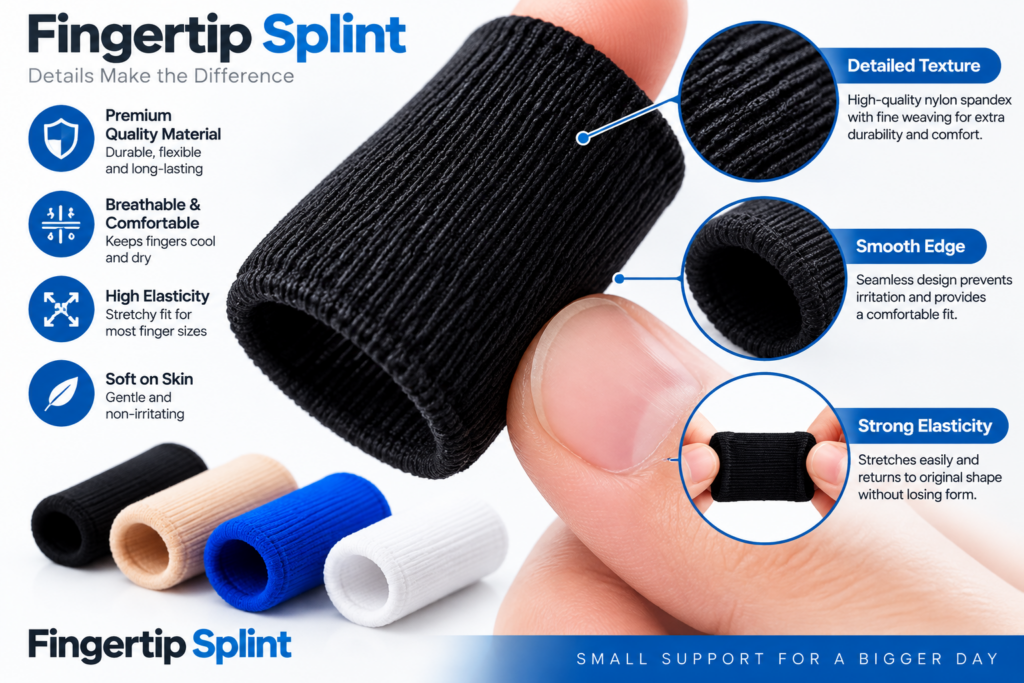
What This Guide Covers
- Quick Answer
- Your Selection Path
- The 7-Step Method
- Step 1 — Purpose
- Step 2 — Coverage
- Step 3 — Size
- Measure Before You Select
- Step 4 — Fit
- Fit During Movement
- Step 5 — Comfort
- Step 6 — Activity
- Step 7 — Quality
- Coverage vs Comfort
- Material Selection
- When a Sleeve Slips
- When a Sleeve Is Too Tight
- Common Selection Mistakes
- What Matters Most?
- Sleeve vs Splint (Brief)
- Product Spotlight
- Before You Select Checklist
- When a Sleeve Isn’t Enough
- FAQ
Quick Answer: How Do You Select Finger Sleeves for Support?
Selecting a finger support sleeve generally involves identifying the intended use, checking the required coverage, measuring the finger according to the manufacturer’s instructions, selecting an appropriate size, and evaluating comfort and flexibility during normal movement. The right sleeve matches your practical requirements rather than providing the maximum possible compression or coverage.
That’s the framework. Below, we’ll walk through each step in detail so you can actually execute the selection process. If you’re still getting familiar with the broader category, the finger support products collection at FingertipSplint offers a useful overview. For deeper context on what sleeves are and how they work, see Finger Support Sleeves Explained: Features, Uses and Design.
Your Selection Path
Here’s the workflow this guide is built around. Keep this in mind as you read — each section below corresponds to one step.
Selection Path Overview
Identify → Measure → Compare → Test → Select
The 7-Step Finger Sleeve Selection Method
This method works for any finger sleeve you evaluate. Each step filters out products that don’t match your requirements, so by the end you’re left with a shortlist of genuinely suitable options.
Step 1 — Identify Your Intended Use
Before looking at any product, ask: why are you considering a finger sleeve? The answer shapes every other decision.
Common Purposes
- Everyday finger support during routine activities
- Coverage of a specific finger area
- Comfort during long wear
- Low-profile use during work or study
- Support during typing, writing, or phone use
- General finger coverage during travel
Purpose Determines
- Which coverage area matters
- How flexible the sleeve should be
- How much bulk is acceptable
- How long you’ll wear it
- What material characteristics are important
- What type of support makes sense
Important: This guide is about product selection, not diagnosis. If you have a specific medical concern, professional assessment matters more than product selection. For a practical look at how sleeves fit into daily life, see How Finger Sleeves Provide Everyday Finger Support and Comfort.
Step 2 — Decide How Much Coverage You Need
Don’t start with the sleeve’s size before deciding what area you actually want covered. Coverage determines which part of the finger is surrounded — and that shapes comfort, mobility, and how the sleeve interacts with daily tasks.
Interactive: Coverage Zones
Tap each zone to see what to consider
👆 Fingertip Coverage
Covers only the end of the finger. Preserves maximum dexterity for fine motor tasks. Useful for precision activities. Consider whether fingertip coverage affects touchscreen use or typing accuracy.
More coverage does not automatically mean better support. Match coverage to the area you actually need.
Coverage affects fit, mobility, comfort, sleeve stability, and how the sleeve interacts with daily activities. For a deeper look at coverage mechanics, see Finger Sleeves for Support: A Guide to Fit, Comfort and Coverage.
Step 3 — Measure Before Selecting a Size
Size is the single most important practical decision in this process. A correctly sized sleeve provides consistent coverage, stays positioned, and feels comfortable. A wrongly sized sleeve — even from a high-quality manufacturer — won’t do its job well.
Interactive: Measure Before You Select
Tap each measurement to see how it affects selection
📏 Length
Measure the area the sleeve is expected to cover. A fingertip sleeve needs a shorter measurement; a full-finger sleeve needs a longer one. Match your measurement to the product’s coverage length.
Compare your measurements with the specific manufacturer’s size chart before ordering. Sizing systems vary between products.
Important: There is no universal finger sleeve measurement system. Each manufacturer uses their own sizing. Always follow the specific product’s instructions rather than applying a generic method.
Step 4 — Evaluate the Fit
Fit determines whether the sleeve actually works for you. Here’s the practical comparison:
❌ Too Loose
- Sleeve moves excessively
- Coverage shifts
- Bunching
- Frequent readjustment
✅ Appropriate Fit
- Stays positioned
- Allows intended movement
- Feels secure
- No uncomfortable pressure
❌ Too Tight
- Excessive pressure
- Tingling
- Numbness
- Discoloration
If you experience numbness, tingling, or discoloration, remove the sleeve and reassess. Persistent symptoms warrant professional advice. For a dedicated comfort-focused guide, see How to Choose a Comfortable Finger Sleeve for Support.
Fit During Finger Movement
Fit isn’t just about how the sleeve sits when the finger is stationary. A sleeve should be evaluated during the movements your actual activity involves.
Interactive: Fit Through Movement
Tap each stage to see what to check
STRAIGHT
BEND
GRIP
RELAXED
Straight — Baseline Position
The starting position. A properly fitted sleeve sits comfortably around the finger without pressure or bunching. This is where you check basic fit before evaluating any movement.
Step 5 — Compare Comfort
Comfort isn’t just about softness. It’s the result of several design factors working together. Here’s what to compare:
🧵 Material
How does it feel against the skin?
↔️ Elasticity
Does it accommodate normal movement?
📦 Thickness
Does it create unnecessary bulk?
✂️ Edges
Do they remain comfortable during movement?
📏 Fit
Does it create excessive pressure?
🏃 Activity
Does it work with your intended activity?
For a deeper comfort breakdown, see the articles linked above in the fit section.
Step 6 — Match the Sleeve to Your Activity
What you do with your hands should shape your selection. Tap each activity to see the priorities.
Interactive: Activity Priorities
Tap each activity to see what to prioritize
TYPING
Repeated movement
WRITING
Grip & movement
SMARTPHONE
Tapping & swiping
STUDYING
Extended use
OFFICE WORK
Keyboard & mouse
TRAVEL
Portability
Typing
Prioritize flexibility, low profile, and secure fit. A thick or loose sleeve can interfere with typing rhythm and accuracy. A thin, well-fitted sleeve designed for everyday use is usually a better match for keyboard work.
For a deeper activity-based guide, see Understanding Finger Support Sleeves for Everyday Activities.
Step 7 — Review Product Quality
Before selecting a final product, examine these construction and quality factors:
🧵 Material
🏗️ Construction
↔️ Elasticity
✂️ Edges
🧶 Seams
📦 Thickness
🛡️ Durability
🧼 Care instructions
📏 Sizing information
🎯 Intended use
For a full quality framework, see What Makes a Good Finger Support Sleeve for Daily Use? For broader buying considerations, see What to Consider When Choosing Finger Support Sleeves.
Coverage vs Comfort: Balancing Priorities
Selection is about balance, not maximization. Here’s how different priorities pull against each other:
| Priority | What to Examine |
|---|---|
| Coverage | Does the sleeve cover the intended area? |
| Comfort | Does it remain comfortable during use? |
| Movement | Can the finger move as intended? |
| Stability | Does the sleeve remain positioned? |
| Daily use | Does its design suit the activity? |
The goal isn’t maximum coverage; it’s suitable coverage for the intended use. More coverage can add bulk, reduce natural movement, and feel more noticeable. Match coverage to what you actually need.
Material Selection: What to Look For
Instead of memorizing material names, evaluate the characteristics that matter for your use.
↔️ Stretch
Can it accommodate intended movement?
🔁 Recovery
Does it return to shape after stretching?
🌟 Texture
How does it feel against the skin?
📦 Thickness
Does it add unnecessary bulk?
💧 Moisture
How does it perform during warm or active use?
🛡️ Durability
How well is it designed for repeated use?
The useful material characteristics depend on how and where the sleeve will be used. For a broader design guide, see Finger Support Sleeves Explained: Features, Uses and Design.
When a Sleeve Slips: What to Check
A sleeve that constantly shifts isn’t doing its job. Before you assume the size is wrong, check these factors:
The sleeve may be too loose or too long for the finger shape.
- Re-measure according to the manufacturer’s instructions
- Compare with the size chart
The sleeve may not be applied at the correct spot on the finger.
- Check the manufacturer’s application guidance
- Adjust position before assuming the size is wrong
Some materials grip better than others depending on the activity.
- Consider whether the material suits your activity
- Check if a different design performs better
High-activity tasks or sweat can affect grip.
- Consider whether a different design suits your activity
- Check the care instructions for moisture management
Don’t just “size down” by default. Choosing a smaller sleeve to solve slipping may create excessive pressure. Check all factors before changing size.
When a Sleeve Is Too Tight
This is a safety-focused section. Excessive tightness isn’t a sign that the sleeve is “working” — it’s a warning sign. Watch for:
⚠️ Excessive pressure
⚡ Tingling
😶 Numbness
🎨 Significant discoloration
😣 Persistent pain or discomfort
Stop using and seek advice: If a sleeve causes any of these symptoms, remove it. If symptoms continue after removal, seek appropriate professional advice. The NHS guide on hand pain and MedlinePlus hand injuries and disorders are reliable starting points.
Common Finger Sleeve Selection Mistakes
These eight mistakes cause most of the frustration in this category. Avoid them:
Mistake 1 — Choosing size without checking the manufacturer’s guidance
Sizing systems vary. Guessing leads to poor fit.
Mistake 2 — Assuming tighter automatically means better
Tightness doesn’t equal support. It causes discomfort and can restrict circulation.
Mistake 3 — Ignoring finger movement
A sleeve that fits at rest may behave differently during movement.
Mistake 4 — Choosing based only on appearance
A visually attractive product may not match your needs.
Mistake 5 — Ignoring coverage
The sleeve needs to cover the area relevant to your purpose.
Mistake 6 — Ignoring the intended activity
A sleeve comfortable for typing may not work for hands-on tasks.
Mistake 7 — Assuming all sleeves provide the same support
Material and construction vary significantly between products.
Mistake 8 — Ignoring discomfort or concerning symptoms
Persistent discomfort isn’t something to push through. It signals that the fit or design needs reconsideration.
Interactive: What Matters Most to You?
A general product-navigation tool, not a medical diagnostic quiz.
Answer all three questions to see your selection priorities.
Finger Sleeve vs Finger Splint: Brief Comparison
This isn’t another full comparison — just enough to clarify where a sleeve fits relative to a splint.
| Priority | Sleeve | Splint |
|---|---|---|
| Flexibility | Generally higher | Often lower |
| Structure | Flexible | More structured |
| Movement control | Generally lower | Generally higher |
| Profile | Often lower | Depends on design |
| Everyday movement | Often prioritized | Depends on purpose |
For a full comparison, see Finger Support Sleeve vs Finger Splint: What’s the Difference?
Explore Finger Sleeves for Finger Support
After working through the selection method, you can evaluate a specific product against your requirements. Here’s the FingertipSplint option to check:
Finger Sleeves for Finger Support
- Flexible sleeve-style design
- Intended for everyday finger support
- Product specifications available on the product page
- Designed for finger coverage and comfort
- Available to explore with current product details
Check the product page for available sizing, product construction, coverage, intended use, material information, and care instructions — the same factors covered in this selection method.
Before You Select: Checklist
Walk through each item before choosing. Tap to mark complete.
When a Finger Sleeve May Not Be Enough
A flexible sleeve shouldn’t automatically be treated as a replacement for:
⚕️ A prescribed support device
🩺 Professional assessment
🦴 A structured immobilization device
🛡️ Protective equipment specifically designed for hazards
Consider professional evaluation when there is significant injury, visible deformity, severe or worsening pain, substantial swelling, persistent numbness or tingling, major loss of movement, or symptoms that aren’t improving.
For trusted guidance, see the AAOS OrthoInfo hand and wrist conditions library, NHS guide on hand pain, and MedlinePlus hand injuries and disorders. Additional perspectives are available from Mayo Clinic, Cleveland Clinic, and Johns Hopkins Medicine. The NIH provides research-based information, and if a neurological component is involved, NINDS is the specialist resource. For regulatory context on medical devices, the FDA is authoritative, and for general public health information, the CDC is a trusted source.
Frequently Asked Questions
Start by identifying which finger needs coverage and what area of that finger the sleeve should cover. Then follow the specific manufacturer’s measurement instructions — sizing systems vary between products, so there is no universal method. Common measurements include finger circumference, length, and sometimes width. Compare your measurement with the product’s size chart, and consider whether you need partial or extended coverage. If you’re between sizes, prioritize comfort — a slightly loose sleeve is usually easier to manage than one that’s too tight.
A properly fitting sleeve should stay reasonably in place without constant adjustment. It should feel snug — comfortable, not painful. It shouldn’t leave deep marks after removal, cause numbness or tingling, or require you to push through discomfort. It should allow your intended finger movement and match the manufacturer’s sizing guidance. If it slips, bunches, or feels excessively tight, the fit is wrong. For a complete fit framework, see the fit, comfort, and coverage guide on this site.
No — it should feel snug, not tight. A snug fit stays in place comfortably. A tight fit causes pressure, numbness, tingling, or leaves deep marks after removal. Tightness doesn’t equal better support. If a sleeve feels too tight, remove it and reconsider the size or design. Persistent numbness, tingling, or discoloration after removal warrants professional advice.
Slipping can have several causes: incorrect size (too loose or wrong length), incorrect positioning during application, material characteristics that don’t grip well for your activity, finger shape, excessive movement, or moisture. Before assuming the size is wrong, check the manufacturer’s application guidance, consider whether the material suits your activity, and examine whether the sleeve stays positioned during the specific movements you do. Don’t just “size down” by default — that could create excessive pressure. For more troubleshooting, see the fit, comfort, and coverage guide.
Coverage should match the area you actually need supported or protected. There’s no universal “right amount.” A fingertip sleeve covers just the tip; a full-finger sleeve covers more. More coverage isn’t automatically better — it can add bulk, reduce natural movement, and feel more noticeable. Think about your purpose first, then match coverage to that. The coverage zones diagram in this article shows the practical differences between coverage patterns.
Flexible finger sleeves are generally designed to preserve natural finger movement — that’s their distinguishing characteristic compared to more structured supports. However, the actual range of movement depends on the specific design and fit. A thinner, more elastic sleeve preserves more movement; a thicker or more structured sleeve may reduce it. If you need movement restriction or stabilization, a sleeve isn’t the right category. Match the flexibility level to your actual activity.
Comfort comes from several design factors working together: appropriate sizing, suitable material softness, appropriate thickness, comfortable edge construction, movement compatibility, and breathability for longer wear. Prioritize correct fit first — a soft material with the wrong size is still uncomfortable. Then match material and construction to your activity and wear duration. For a full comfort-focused guide, see the dedicated comfort article on this site.
Not necessarily. Thickness affects bulk, flexibility, grip, dexterity, and how noticeable the sleeve feels. Thinner sleeves preserve dexterity — good for typing, writing, and smartphone use. Thicker sleeves may offer more cushioning but can feel bulkier and reduce dexterity. Neither is universally better. Match thickness to your activity and comfort preferences. If you need both movement and coverage, a thin design with broad coverage may work better than a thick design with narrow coverage.
Not always. Finger sizes vary significantly — even on the same hand. The thumb, index finger, and little finger often differ in circumference and length. A sleeve sized for one finger may not fit another comfortably. Always measure the specific finger you intend to use the sleeve on and match the measurement to the manufacturer’s size chart. Don’t assume that a size that works for one finger will work for another.
No. Finger sleeves are typically soft, flexible, and designed for coverage, light support, and everyday comfort with preserved finger movement. Finger splints are structured and often designed to stabilize, position, or restrict movement. They serve different purposes. A sleeve doesn’t substitute for a splint when stabilization is needed. If you’re unsure which category matches your situation, the dedicated sleeve vs splint comparison article covers the differences in detail.
Remove the sleeve immediately. Numbness, tingling, significant discoloration, or persistent pain are warning signs that the sleeve is too tight or inappropriate for your situation. Don’t try to “break in” a sleeve that causes these symptoms. Check whether you have the correct size and consider a different design. If symptoms continue after removal, seek appropriate professional advice. These symptoms shouldn’t be attributed to “getting used to” the sleeve.
Seek professional advice if you have a significant injury, visible deformity, severe or worsening pain, major swelling, persistent numbness or tingling, substantial loss of movement, or symptoms that aren’t improving. Also seek advice if a healthcare professional has prescribed or recommended a specific support device, or if you’re unsure whether a flexible sleeve is appropriate. A selection guide can help you compare products, but it can’t diagnose what’s causing your symptoms. Trusted resources include AAOS OrthoInfo, NHS, MedlinePlus, Mayo Clinic, and Cleveland Clinic.
Selection Method Understood. Now Apply It.
Identify → Measure → Compare → Test → Select. Use this workflow to evaluate any finger sleeve — including the FingertipSplint option. Match the product to your actual requirements.
The Bottom Line on Selecting Finger Sleeves for Support
Selecting a finger sleeve is a decision-making process, not a guessing game. Working through the steps — purpose, coverage, measurement, fit, comfort, activity, and quality — gives you a clear framework for evaluating any product. The most important step is measurement, because even a well-designed sleeve can’t perform if it doesn’t fit properly.
Understanding fit, comfort, and coverage together is more useful than optimizing for any single factor. When you approach selection this way, you can compare products with confidence — and avoid the mistakes that lead to wasted money and frustration.
For readers ready to apply this method to a specific product, the Finger Sleeves for Finger Support product page is the natural next step. For a broader view of product features, see Finger Support Products Explained: Where Do Sleeves Fit In? And for the full buying framework, see What to Consider When Choosing Finger Support Sleeves. Explore the full FingertipSplint blog library for more guides.
This article is for general information only and is not a substitute for professional medical advice. Always consult a qualified healthcare provider for diagnosis and treatment of any medical condition.