
Understanding Finger Support Sleeves for Everyday Activities
Your hands do very different things throughout the day — checking your phone in the morning, typing at work, writing notes, holding books, using a laptop, doing household tasks, and traveling. A finger sleeve that feels right for one activity may not have the same requirements for another. This guide is about how activities shape what you should look for — from movement and contact to duration and comfort.
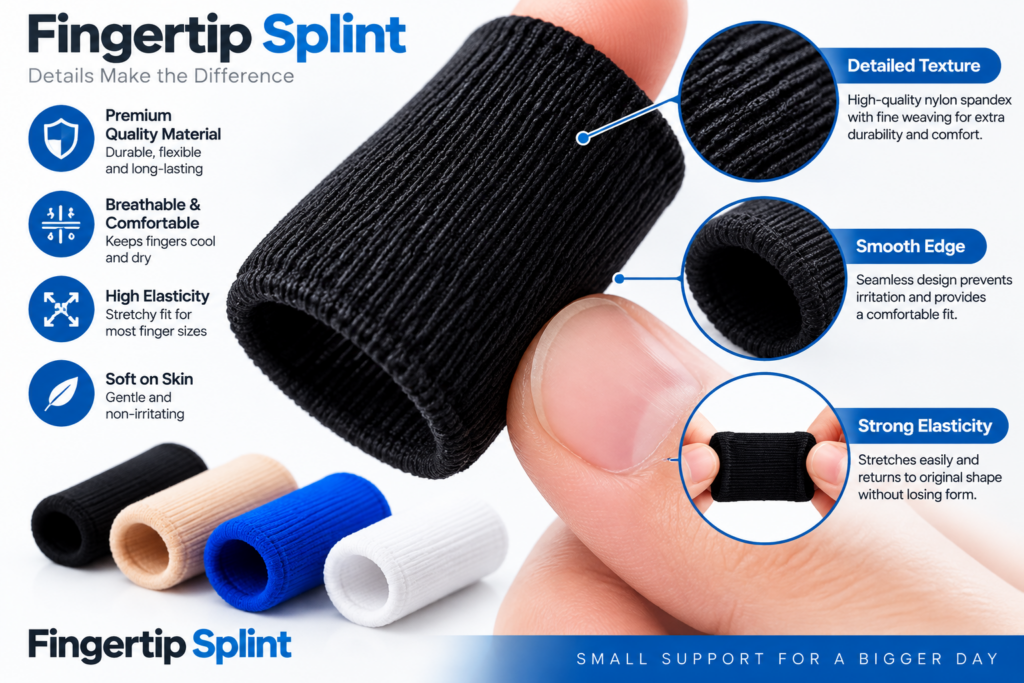
What This Guide Covers
- Quick Answer
- Why Everyday Activities Matter
- Movement + Contact + Duration
- Typing
- Writing
- Studying
- Smartphone Use
- Office Work
- Household Activities
- Travel
- Activity vs Requirement Table
- 3D: A Day With Finger Support
- How Movement Changes
- Fit During Activities
- Coverage & Movement Balance
- Comfort During Repeated Activities
- When a Sleeve Slips
- Which Activity Are You Doing?
- When Activity Use Isn’t Appropriate
- Common Mistakes
- Product Spotlight
- FAQ
Quick Answer: How Can Finger Support Sleeves Be Used During Everyday Activities?
Finger support sleeves may be considered for everyday activities where their design, fit, flexibility, coverage, and comfort are compatible with the task. Different activities require different levels of finger movement and interaction with objects, so suitability depends on the specific sleeve and the specific activity.
That’s the practical version. If you’re new to the category, the Finger Support Sleeves Explained: Features, Uses and Design article walks through the fundamentals. Below, we’ll look at how each major everyday activity creates its own set of requirements.
Why Everyday Activities Matter
Finger support isn’t used in a vacuum. It’s used while you’re doing something — and that “something” shapes what the sleeve needs to do. Three factors matter most:
Movement
Does the activity require bending, straightening, grip, fine finger movements, or repeated movement?
Contact
Does the finger interact with a keyboard, pen, phone, tools, or household objects?
Duration
Is the activity short, repeated, or extended? How long will you wear the sleeve while doing it?
Once you understand what an activity demands, you can evaluate whether a specific sleeve’s design matches those demands. This is the core framework for the rest of this article.
Finger Support Sleeves for Typing
Typing involves repeated finger movement, keyboard contact, and often extended periods of use. It’s one of the most movement-intensive daily activities — and it’s where sleeve design matters a lot.
What Typing Requires
- Repeated finger flexion and extension
- Fingertip contact with keys
- Fine movement precision
- Secure positioning during typing
- Sustained comfort over long sessions
What to Consider in a Sleeve
- Flexibility — allows natural finger movement
- Low bulk — doesn’t interfere with key contact
- Secure fit — stays in place during repeated movement
- Appropriate coverage — doesn’t block fingertip sensitivity
Practical question: Will the sleeve interfere with the finger movement needed to press keys comfortably? If yes, it’s not a good match for typing.
Typing Checklist
For a broader look at how comfort and support interact during daily use, see How Finger Sleeves Provide Everyday Finger Support and Comfort.
Finger Sleeves for Writing
Writing involves a chain of interactions: your finger, the pen, the grip, and the movement. Each link matters, and a sleeve affects all of them.
Interactive: Writing Considerations
Tap each factor to see what to consider
GRIP
Holding the pen
MOVEMENT
Finger bending
COVERAGE
Area covered
FIT
Stays in place
Grip
A sleeve that’s too thick may interfere with pen control. A thin, flexible sleeve that preserves grip compatibility is usually a better choice for writing.
For the broader comfort angle, see How to Choose a Comfortable Finger Sleeve for Support.
Finger Support During Studying
Studying isn’t a single activity — it’s a combination of several. A student may write, type, read, use a smartphone, take notes, and handle books within a single session. That makes versatility important.
The required finger movement changes throughout the day. A sleeve that works well for one part of studying may not be ideal for another. In this context, versatility matters more than optimizing for any single activity.
Finger Sleeves for Smartphone Use
Smartphone use involves touchscreen interaction, thumb and finger movement, tapping, swiping, and holding the phone. It’s a modern activity that many buyers don’t consider — but it’s part of daily life.
Interactive: Smartphone Movements
Tap each movement to see what matters
TAP
SWIPE
TYPE
HOLD
Tap
A thin sleeve preserves touchscreen sensitivity. A thick sleeve may reduce it and affect tap accuracy. Check that the material doesn’t interfere with the screen’s responsiveness.
Key message: A sleeve used during smartphone activities should be evaluated according to the movement and contact required by the device — not just whether it fits.
Finger Support for Office Work
Office work combines several desk activities into a single workday. Here’s the practical picture:
Typical Desk Activities
- Keyboard typing
- Mouse use
- Writing notes
- Phone calls
- Handling documents
- Handling small objects
What to Consider
- Low interference with keyboard and mouse
- Secure fit through varied movements
- Comfort over an extended workday
- Versatility across multiple activities
Finger Sleeves During Light Household Activities
Household activities involve organizing items, light handling tasks, opening and closing everyday objects, and basic activities. Here, priorities shift toward fit, coverage, and usability.
Important safety note: An ordinary finger sleeve should not be treated as protection against heat, sharp objects, chemicals, or other hazards unless the manufacturer specifically states that it is rated for that purpose. For tasks involving these hazards, use appropriate protective equipment.
For the convenience angle of household and daily use, see Why Choose Finger Sleeves for Convenient Finger Support?
Finger Support While Traveling
Travel combines many of the same hand activities as home and work, but in a less predictable environment. Portability, fit, comfort, and activity compatibility matter most.
🧳 Packing and carrying
📱 Smartphone use
✍️ Writing
📖 Reading
💻 Laptop use
🤲 General hand activities
Activity vs Sleeve Requirement Table
Here’s the practical evaluation framework. This isn’t a medical recommendation — it’s a way to think about what matters for each activity.
| Everyday Activity | Main Considerations |
|---|---|
| ⌨️ Typing | Flexibility + low bulk |
| ✍️ Writing | Grip + movement + comfort |
| 📚 Studying | Comfort + flexibility |
| 📱 Smartphone use | Mobility + suitable coverage |
| 💼 Office work | Fit + movement |
| ✈️ Travel | Portability + secure positioning |
| 🏠 Light household tasks | Fit + coverage + usability |
| 📖 Reading / holding books | Comfort + movement |
| 🖥️ Desk activities | Flexibility + low interference |
Interactive: A Day With Finger Support
Tap each moment to see the movement, contact, and fit considerations
🌅 8 AM — Smartphone
Movement: Fine tapping and swiping with thumb or finger
Contact: Touchscreen
Fit consideration: Thin material for touchscreen sensitivity
Comfort consideration: No interference with grip or screen access
How Movement Changes From Activity to Activity
Different activities require different types of finger movement. Understanding this helps you match the sleeve to the task.
Fine Movement
Typing, writing, touchscreen use. Requires precision and dexterity. Demands thin, flexible sleeves.
Repeated Movement
Typing, writing, desk work. Requires sleeves that stay positioned through continuous motion.
Grip
Holding objects. Requires sleeves that compress naturally without bunching.
Limited Movement
Some activities involve less finger movement. Coverage and stability may matter more than flexibility.
Key principle: A sleeve’s flexibility should be considered in relation to the movement the activity actually requires.
Fit During Everyday Activities
Fit isn’t static — it’s dynamic. A sleeve should be evaluated through the movements your activity involves, not just while your hand is at rest.
At Rest
Does the sleeve stay positioned comfortably? Is there any pressure or bunching at the baseline position?
During Movement
Does the sleeve shift, rotate, or slide when the finger moves? Does it maintain coverage?
During Grip
Does it bunch or fold when gripping objects? Does it create pressure points?
During Repeated Movement
Does it remain comfortable after extended activity? Does it require adjustment mid-task?
For the full fit framework, see Finger Sleeves for Support: A Guide to Fit, Comfort and Coverage.
Interactive: Coverage & Movement Balance
Explore how coverage and movement interact. Select where you want to land on each slider.
Select your coverage and movement requirements to see considerations.
Comfort During Repeated Activities
Comfort changes over time. A sleeve that feels fine for five minutes may feel different after an hour of repeated activity. Here’s what to consider:
📏 Fit
Remains comfortable over time.
⚖️ Pressure
No accumulating pressure points.
🧵 Material
Comfortable against skin for extended wear.
📦 Thickness
Doesn’t feel heavier as time passes.
✂️ Edges
Don’t rub or irritate during movement.
💧 Moisture
Handles sweat reasonably well.
What If the Sleeve Slips During an Activity?
Slipping during activity can have several causes. Before assuming the size is wrong, check these factors:
Possible Causes
- Incorrect sizing
- Incorrect positioning
- Finger shape mismatch
- Excessive movement from activity
- Moisture accumulation
- Product design mismatch
- Activity requires more movement than the sleeve accommodates
What to Check
- Re-measure according to manufacturer instructions
- Verify correct application position
- Consider whether the material suits your activity
- Check whether the sleeve’s design matches your movement level
- Consider a different design if the current one can’t handle the activity
For full troubleshooting guidance, see Finger Sleeves for Support: A Guide to Fit, Comfort and Coverage.
Interactive: Which Activity Are You Doing?
Select your activity to see the evaluation priorities. This is an educational tool, not a medical recommendation.
Select your activity above to see evaluation priorities.
When an Everyday Activity May Not Be Appropriate
A finger sleeve should not automatically be treated as appropriate for high-risk or hazardous activities. Specifically, an ordinary finger sleeve isn’t designed for:
⚠️ High-risk work environments
🔪 Sharp-object handling
🔥 Heat exposure
🧪 Chemical exposure
🏗️ Heavy-duty tasks
Important: Unless the product is specifically designed and rated for that environment, don’t rely on a general-purpose sleeve. Also remember that a sleeve isn’t automatically a substitute for professional assessment or a prescribed/structured support device.
For trusted guidance, see the AAOS OrthoInfo hand and wrist conditions library, NHS guide on hand pain, and MedlinePlus hand injuries and disorders. Additional perspectives are available from Mayo Clinic, Cleveland Clinic, and Johns Hopkins Medicine. The NIH provides research-based information, and if a neurological component is involved, NINDS is the specialist resource. For regulatory context on medical devices, the FDA is authoritative, and for general public health information, the CDC is a trusted source.
Common Mistakes
These eight mistakes are easy to make when using finger sleeves during everyday activities:
The activity determines what the sleeve needs to do. Match the sleeve to the task.
Movement requirements vary by activity. A sleeve that works at rest may not work during motion.
More coverage isn’t automatically better. It can add bulk and interfere with dexterity.
Grip is the most demanding position for fit. A sleeve that fits at rest may bunch during grip.
Flexibility is a design characteristic, not a guarantee of suitability. Match to your activity.
Standard finger sleeves aren’t rated for hazard protection. Use proper protective equipment for hazardous tasks.
Comfort during five minutes isn’t the same as comfort during an hour. Pay attention to sustained comfort.
Different activities create different requirements. One sleeve may work well for typing but not for household tasks.
Explore Finger Sleeves for Finger Support
Before using a finger sleeve during your daily routine, check the product against your activity requirements. Here’s the FingertipSplint option to examine:
Finger Sleeves for Finger Support
- Flexible sleeve-style design
- Intended for everyday finger support
- Product specifications available on the product page
- Designed for finger coverage and comfort
- Available to explore with current product details
Check the product page for design details, coverage, material, size information, intended use, and care instructions. For quality considerations, see What Makes a Good Finger Support Sleeve for Daily Use?
Frequently Asked Questions
Yes, many people use finger support sleeves during everyday activities like typing, writing, smartphone use, office work, and household tasks. Their flexibility and low-profile design make them practical for daily wear. However, different activities require different characteristics. A sleeve that works well for one activity may not be ideal for another. Consider what movement the activity requires, what contact points are involved, and how long you’ll be wearing the sleeve during that activity.
Many people type with finger sleeves. For typing, prioritize low bulk, flexibility, secure fit, and appropriate coverage. A thick or loose sleeve can interfere with typing rhythm and accuracy. A thin, well-fitted sleeve designed for everyday use is usually a better match for keyboard work. Test the sleeve during actual typing before committing to long work sessions — comfort at rest is different from comfort during active typing.
Yes, but consider grip and dexterity. Writing involves a chain of interactions — your finger, the pen, the grip, and the movement. A sleeve that’s too thick may interfere with pen control. A thin, flexible sleeve that allows natural finger movement is usually a better choice. If you write for extended periods, breathability and comfort during repeated movement become especially important.
Studying isn’t a single activity — it combines writing, typing, reading, smartphone use, and note-taking. A student may perform several different hand activities in one session. Because of this, versatility matters. A sleeve that works reasonably well across multiple activity types is often more useful than a sleeve that’s optimized for just one. Consider whether the sleeve stays comfortable and in position through varied movements.
They can be, but fingertip coverage and material thickness matter. A thin sleeve preserves touchscreen sensitivity, while a thick sleeve may reduce it and affect tap accuracy. Consider whether the sleeve allows you to tap, swipe, and type on screen accurately. Also check whether the material provides enough grip to hold the phone comfortably. This is a modern activity worth evaluating specifically if phone use is part of your daily routine.
Work activities vary widely. Office work combines typing, mouse use, writing, and document handling. Manual work may involve grip, repetitive movement, and durability considerations. Match the sleeve to your actual work activities rather than assuming one design works for everything. If your work involves hazards (sharp objects, heat, chemicals, heavy machinery), a general-purpose finger sleeve isn’t appropriate — use proper protective equipment.
Yes, many people do. Travel involves a mix of activities — smartphone use, writing, reading, laptop use, packing, and general hand tasks. Portability, fit, comfort, and activity compatibility are the main considerations. A compact, easy-to-pack sleeve is convenient for travel, and maintainability matters too since you may need to clean or store it while away from home.
Flexible sleeves are generally designed to preserve natural finger movement, which is their distinguishing characteristic compared to structured supports. However, the actual range of movement depends on the specific design and fit. A thicker or more structured sleeve may reduce movement to some degree. Match the flexibility level to the movement your activity actually requires — not to a single standard.
Fit isn’t static — it’s dynamic. A sleeve should be evaluated through the movements your activity involves, not just while your hand is at rest. Check whether it stays positioned during movement, whether it shifts during grip, and whether it remains comfortable after repeated activity. A sleeve that fits well at rest may behave differently during typing, writing, or gripping objects.
Slipping during activity can have several causes: incorrect size, incorrect positioning, finger shape mismatch, excessive movement from the activity, moisture accumulation, or a product design that doesn’t match the movement level required. Before assuming the size is wrong, check the manufacturer’s application guidance and consider whether the sleeve’s design is suited to your activity.
Yes, for light household activities like organizing items and basic handling tasks. Priorities here are fit, coverage, and usability. However, an ordinary finger sleeve should not be treated as protection against heat, sharp objects, chemicals, or other hazards unless the manufacturer specifically states that it is rated for that purpose. For tasks involving these hazards, use appropriate protective equipment.
No. A general-purpose finger sleeve is a support product, not protective equipment. It isn’t designed to protect against sharp objects, heat, chemicals, heavy impact, or workplace hazards. If you need protection from a specific hazard, look for equipment specifically designed for that purpose. Don’t confuse support with protection — they serve different functions.
Remove it and reassess. Discomfort during activity is a signal that the fit, size, or design isn’t working for you in that context. Check whether the sleeve is correctly sized and positioned. Consider whether the design matches the movement level of your activity. If you experience numbness, tingling, significant discoloration, or persistent pain, seek appropriate professional advice. Don’t push through discomfort — it’s not a sign of proper support.
Seek professional advice if you have a significant injury, visible deformity, severe or worsening pain, major swelling, persistent numbness or tingling, substantial loss of movement, or symptoms that aren’t improving. Also seek advice if a healthcare professional has prescribed or recommended a specific support device. An activity-based guide can help you evaluate product suitability, but it can’t diagnose what’s causing your symptoms. Trusted resources include AAOS OrthoInfo, NHS, MedlinePlus, Mayo Clinic, and Cleveland Clinic.
Match the Sleeve to the Activity
Every activity creates its own requirements. Movement, contact, and duration shape what matters. Use this framework to evaluate any finger sleeve against your daily routines. Movement → Contact → Duration → Sleeve Consideration
The Bottom Line on Finger Support for Everyday Activities
Different activities create different requirements for finger support. Typing needs flexibility and low bulk. Writing needs grip compatibility and movement. Smartphone use needs thin material and mobility. Studying needs versatility across multiple hand tasks. Office work needs low interference across a range of activities. Household tasks need secure fit and appropriate coverage. Travel needs portability and comfort.
The most useful approach is to think about your actual routine — what you do most, what movement those activities require, and what would make a sleeve practical for you. When a sleeve matches those factors, it works well. When it doesn’t, even a well-made sleeve can feel like the wrong choice.
For readers ready to evaluate a specific product using this framework, the Finger Sleeves for Finger Support product page is the natural next step. For the convenience angle, see Why Choose Finger Sleeves for Convenient Finger Support? For a comparison with structured support, see Finger Support Sleeve vs Finger Splint: What’s the Difference? Explore the full FingertipSplint blog library for more guides.
This article is for general information only and is not a substitute for professional medical advice. Always consult a qualified healthcare provider for diagnosis and treatment of any medical condition.