
A Beginner’s Guide to Finger Support Sleeves and Their Uses
If you’ve never used a finger support sleeve before, the terminology, product options, and sizing details can feel overwhelming. This beginner’s guide walks you through the basics in a simple order: what a sleeve is, how it works, what it’s used for, how to fit it, how to put it on, and what to know before your first purchase.
What This Guide Covers
- Quick Answer
- In Simple Terms
- How They Work
- Main Parts
- What They’re Used For
- Work & Study
- Everyday Hand Activities
- Beginner’s Support Spectrum
- Sleeve vs Splint Basics
- Choosing Your First Sleeve
- Sizing Basics
- How It Should Feel
- How to Put It On
- Beginner Mistakes
- Materials
- Comfort for First-Time Users
- Caring for Your Sleeve
- What They Can’t Do
- When to Seek Advice
- I’m New to Finger Sleeves
- 3D: Your First Finger Sleeve
- Quick-Start Checklist
- Product Spotlight
- FAQ
Quick Answer: What Is a Finger Support Sleeve?
A finger support sleeve is a wearable sleeve-style support designed to fit around part or all of a finger. Depending on its design, it may provide coverage, light support, cushioning, or gentle compression while allowing natural finger movement. Sleeves generally prioritize flexibility and everyday usability — they’re not the same as rigid splints.
Beginner tip: Start with the product’s intended use, sizing information, and manufacturer instructions rather than assuming every finger sleeve works the same way.
If you want a slightly deeper definition-focused guide, the Finger Sleeves for Finger Support: What Are They and How Do They Work? article explains the mechanics in more detail. This beginner’s guide focuses on getting you oriented and ready to use one.
Finger Support Sleeves in Simple Terms
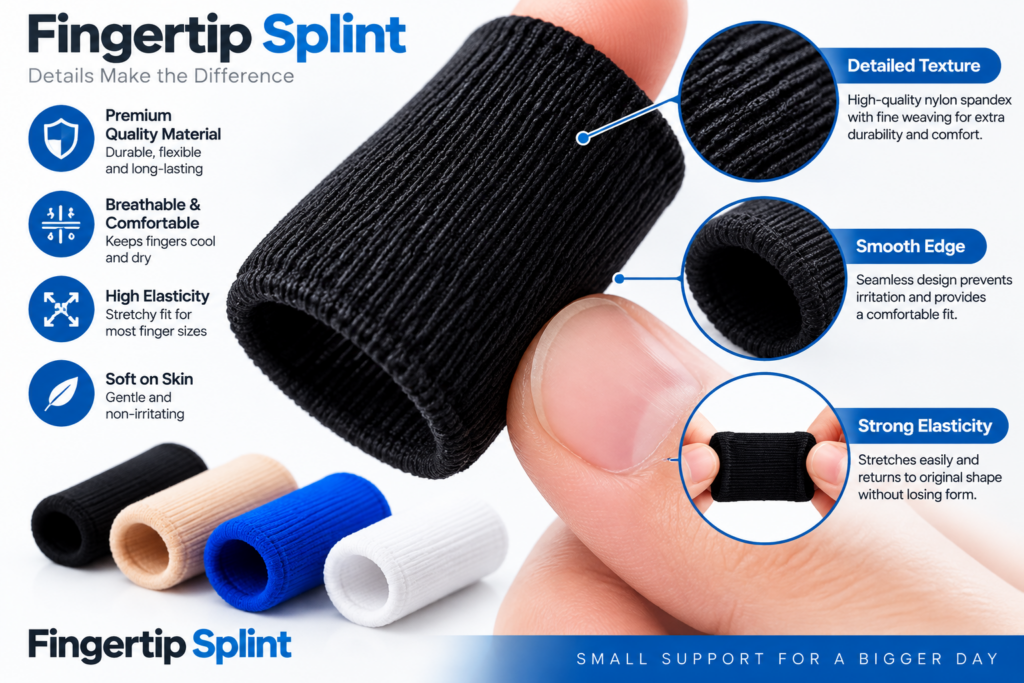
A finger support sleeve is essentially a flexible covering that fits around part or all of a finger. Think of it as a soft, stretchy layer that sits around the finger and provides some combination of support, coverage, or cushioning.
🧵 Flexible Construction
Made from stretchy or soft material that conforms to the finger.
🎯 Finger Coverage
Covers a section or most of the finger, depending on design.
📏 Fit
Relies on correct size and material stretch to stay in place.
💪 Support
Provides light support, coverage, or cushioning depending on construction.
🔄 Movement
Generally allows natural finger movement rather than restricting it.
☁️ Comfort
Designed for everyday wear with materials that feel suitable against skin.
Important: Not every sleeve has identical construction or provides the same level of support. Different designs prioritize different things — some focus on coverage, others on comfort, others on flexibility.
How Finger Support Sleeves Generally Work
You don’t need a technical understanding to use a sleeve well, but knowing the basics helps you evaluate products. Here’s the simple relationship:
Interactive 3D: How a Sleeve Works
Tap each factor to see how it contributes
🧵 Material
The material determines how the sleeve feels, moves, and holds up. Flexible materials conform to the finger and allow movement. Material choice affects comfort, breathability, and durability.
These factors work together. No single element determines how a sleeve performs.
Understanding the Main Parts of a Finger Sleeve
When you shop for a finger sleeve, you’ll encounter several terms. Here’s a quick glossary to help you understand product descriptions:
Sleeve Body
The main fabric section that wraps around the finger.
Opening
Where the finger enters the sleeve. May be at one or both ends.
Edges
Where the sleeve ends. Smooth edges reduce friction and irritation.
Coverage Area
The part of the finger the sleeve surrounds — tip, middle, joint, or extended.
Stretch / Flexible Material
The stretchy construction that allows the sleeve to conform and stay in place.
Seams
Where the material is joined. Seam placement affects comfort during movement.
If you want to understand construction features more deeply, see Finger Support Sleeves Explained: Features, Uses and Design.
What Are Finger Support Sleeves Used For?
This is probably your biggest beginner question — and it deserves a proper answer. Finger sleeves are used across a wide range of everyday activities. They’re not designed for medical treatment, but they can provide flexible support during routine tasks.
Here’s the framework for thinking about it: Activity → Required Movement → Fit → Support Characteristics.
Activities involving frequent finger movement may make flexibility and low profile important characteristics to consider. Activities requiring less movement may allow for different design priorities.
Finger Support Sleeves for Work and Study
If your daily routine involves a lot of hands-on work, work and study are the most common uses for a flexible finger sleeve.
🎓 Students
- Writing notes by hand
- Typing assignments
- Laptop use
- Note-taking
- Smartphone use between classes
💼 Office Users
- Keyboard work
- Mouse use
- Document handling
- Repetitive desk activities
- Phone calls
For both situations, focus on comfort, movement, fit, and usability — not medical outcomes. For more detail, see Understanding Finger Support Sleeves for Everyday Activities.
Finger Support Sleeves for Everyday Hand Activities
Beyond work and study, finger sleeves fit into other everyday scenarios:
👕 Getting dressed
🛒 Handling everyday objects
🏠 Light household tasks
📦 Carrying small items
✈️ Travel
📱 Routine phone use
The key question is: does the support fit naturally into the activity? If it interferes, slips, or feels uncomfortable, the design isn’t matching the activity.
Beginner’s Guide to the Support Spectrum
Not all finger support is the same. It helps to understand the spectrum from most flexible to most structured — even if you’re new to the category.
Interactive: Support Spectrum
Tap each level to see the difference
🧵 Finger Sleeve
Flexible, low-profile design. Prioritizes coverage, comfort, and everyday usability while preserving natural finger movement. Designed for daily activities where flexibility remains important.
This is a conceptual framework, not a strict medical classification. Product terminology and construction vary.
Beginner takeaway: More structure isn’t automatically better. The relevant design depends on the intended use and how much movement or positioning is appropriate.
Finger Sleeve vs Finger Splint: Basic Difference
This is one of the first questions beginners ask. Here’s the quick version:
| Finger Sleeve | Finger Splint |
|---|---|
| Generally flexible | Often more structured |
| Usually emphasizes coverage and flexibility | Often emphasizes stabilization or movement control |
| Often low profile | May be bulkier |
| Usually relies on stretch and fit | May use rigid or semi-rigid components |
For the full comparison, see Finger Support Sleeve vs Finger Splint: What’s the Difference?
How to Choose Your First Finger Support Sleeve
If this is your first purchase, don’t overthink it. Start with these five questions:
Answering these five questions gives you enough information to make a sensible first purchase. For a broader framework, see What to Consider When Choosing Finger Support Sleeves.
Beginner’s Guide to Finger Sleeve Sizing
Sizing is where beginners make the most mistakes. Here’s what to know:
What to Do
- Check the manufacturer’s size chart
- Measure according to their instructions
- Consider finger circumference and length where applicable
- Check how much the sleeve stretches
- Make sure the sleeve doesn’t bunch or slide excessively
What NOT to Do
- Assume all brands use identical sizing
- Guess based on appearance
- Choose a tighter size hoping for “extra support”
- Ignore manufacturer measurement instructions
- Assume the same size works across different fingers
Beginner tip: Measure the specific finger you’ll use the sleeve on. Finger sizes vary significantly — even on the same hand.
How Should a Finger Support Sleeve Feel?
Here’s the beginner-friendly version of what a good fit feels like:
Too Loose
- Slipping during movement
- Bunching up
- Coverage shifts
- Requires constant adjustment
Appropriate Fit
- Stays positioned
- Feels secure, not tight
- Allows intended movement
- Comfortable during use
Too Tight
- Excessive pressure
- Numbness or tingling
- Discoloration
- Persistent discomfort
Stop and reassess: If a sleeve causes numbness, tingling, significant discoloration, or persistent pain, remove it. If symptoms continue after removal, seek appropriate professional advice. The NHS guide on hand pain and MedlinePlus hand injuries and disorders are useful starting points.
How to Put on a Finger Support Sleeve
Here’s the simple step-by-step method for first-time users:
Common Beginner Mistakes
These eight mistakes are easy to make if you’re new to finger sleeves. Avoiding them will save you time and frustration:
A sleeve that looks right may not fit right. Always check the size chart.
Tightness doesn’t equal support. Excessive tightness causes discomfort.
Different fingers need different sizes. Measure the specific finger.
Wrong orientation or incomplete positioning reduces effectiveness.
These indicate a fit or design mismatch. Address them, don’t ignore them.
Sleeves preserve movement; splints restrict it. Different purposes.
Materials, construction, and coverage vary significantly.
Significant symptoms need professional evaluation, not product selection.
Finger Support Sleeve Materials
Materials affect how the sleeve feels and performs. You don’t need to memorize material names — just understand what different material characteristics influence:
↔️ Stretch
🔄 Flexibility
📦 Thickness
☁️ Skin feel
🛡️ Durability
💧 Moisture handling
Important: Material alone does not determine whether a sleeve is appropriate. Fit and construction matter too. For a deeper look at design, see Finger Support Sleeves Explained: Features, Uses and Design.
Comfort for First-Time Users
Comfort isn’t just about soft material. Here’s the beginner-friendly framework:
A sleeve that looks comfortable may not feel comfortable if it’s incorrectly sized. Even a soft material can feel uncomfortable if the fit or coverage doesn’t suit your activity. For a comfort-focused guide, see How to Choose a Comfortable Finger Sleeve for Support.
Caring for a Finger Support Sleeve
Here’s the beginner-friendly care checklist:
🧼 Follow manufacturer washing instructions
🧴 Use the recommended cleaning method
☀️ Allow it to dry properly
🔍 Inspect for wear
🚫 Don’t continue using a damaged product
📦 Store it appropriately
Important: Don’t invent washing temperatures or cleaning chemicals. Follow the specific product instructions that come with your sleeve.
What Finger Support Sleeves Cannot Automatically Do
This is important for setting realistic expectations. A finger sleeve should not automatically be assumed to:
❌ Diagnose a problem
❌ Treat every finger condition
❌ Replace a prescribed device
❌ Immobilize a finger like a splint
❌ Protect against sharp objects
❌ Protect against heat or chemicals
These limitations aren’t flaws — they’re simply what a flexible support product is designed for. If you need those capabilities, a different category is more appropriate.
When a Beginner Should Seek Professional Advice
Product selection isn’t a substitute for professional assessment. Consider consulting a qualified healthcare professional if you have:
🩹 Significant injury
🦴 Visible deformity
📈 Severe or worsening pain
💧 Substantial swelling
⚡ Persistent numbness or tingling
🚫 Major loss of finger movement
⏳ Symptoms that aren’t improving
For trusted guidance, see the AAOS OrthoInfo hand and wrist conditions library, NHS guide on hand pain, and MedlinePlus hand injuries and disorders. Additional perspectives are available from Mayo Clinic, Cleveland Clinic, and Johns Hopkins Medicine. The NIH provides research-based information, and if a neurological component is involved, NINDS is the specialist resource. For regulatory context on medical devices, the FDA is authoritative, and for general public health information, the CDC is a trusted source.
Interactive: I’m New to Finger Sleeves
Answer three questions to see what to compare when choosing your first sleeve. This is educational guidance, not a medical recommendation.
Answer all three questions to see your comparison factors.
Interactive 3D: Your First Finger Sleeve
Tap each factor to understand what to check
🎯 Coverage
What area does the sleeve cover? Some sleeves cover the fingertip, others cover a middle section, and some cover most of the finger. Match coverage to what you actually need.
UNDERSTAND → FIT → USE → CHECK
Beginner’s Quick-Start Checklist
Walk through each item as you get started. Tap to mark complete.
Before Buying
Before Wearing
During Use
Product Spotlight: A Product to Examine Once You Understand the Basics
Now that you understand what finger sleeves are, how they work, and what they’re used for, you’re ready to evaluate an actual product. Here’s what to check on the FingertipSplint option:
Finger Sleeves for Finger Support
- Flexible sleeve-style design
- Intended for everyday finger support
- Product specifications available on the product page
- Designed for finger coverage and comfort
- Available to explore with current product details
Check the product page for sizing information, material, coverage details, and intended use. For fit guidance, see Finger Sleeves for Support: A Guide to Fit, Comfort and Coverage. For the broader product landscape, see Finger Support Products Explained: Where Do Sleeves Fit In?
Frequently Asked Questions
Finger support sleeves are flexible, sleeve-style wearable products designed to fit around part or all of a finger. Depending on their material and construction, they may provide coverage, light support, cushioning, or gentle compression while allowing natural finger movement. They’re generally not the same as rigid splints, which are designed to stabilize or restrict movement.
Finger sleeves are used across a wide range of everyday activities including typing, writing, smartphone use, studying, office work, light household tasks, and travel. They provide flexible support and coverage during routine activities where preserving natural finger movement is important. They’re not designed for medical treatment or immobilization.
Finger sleeves work through the interaction of four factors: material, fit, coverage, and flexibility. The material conforms to the finger and provides a supportive layer. Fit determines whether the sleeve stays in position. Coverage defines which part of the finger receives support. Flexibility allows the sleeve to move with the finger rather than restricting it. These factors work together to create the wearing experience.
Comfort depends on several factors working together: appropriate fit, suitable material, manageable pressure, adequate flexibility, and correct coverage for the activity. A well-fitted sleeve in a breathable material can be comfortable for extended wear. A poorly fitted sleeve — whether too tight or too loose — can become uncomfortable quickly. Fit is usually the biggest factor.
Many people type with finger sleeves. For typing, prioritize low bulk, flexibility, secure fit, and comfort during repeated movement. A thick or loose sleeve can interfere with typing rhythm and accuracy. A thin, well-fitted sleeve designed for everyday use is usually a better match for keyboard work.
Yes, many people use finger sleeves during everyday activities like typing, writing, smartphone use, office work, and light household tasks. Their flexibility and low-profile design make them practical for daily wear. However, comfort during rest may differ from comfort during activity, so it’s worth evaluating the sleeve during the specific activities you do most.
A properly fitting sleeve should stay reasonably in place without constant adjustment. It should feel snug, not painful. It shouldn’t leave deep marks after removal, cause numbness or tingling, or require pushing through discomfort. It should allow your intended finger movement and match the manufacturer’s sizing guidance.
Follow the specific manufacturer’s sizing instructions. Sizing systems vary between products, so there isn’t a universal measurement method. Common measurements include finger circumference and sometimes length. Measure the specific finger you’ll use the sleeve on, compare with the manufacturer’s size chart, and follow their guidance. If you’re between sizes, prioritize comfort over a tighter fit.
No. Finger sleeves are typically soft, flexible, and designed for coverage, light support, and everyday comfort with preserved finger movement. Finger splints are structured and often designed to stabilize, position, or restrict movement. They serve different purposes. A sleeve is not a substitute for a splint when stabilization is needed.
Flexible sleeves are generally designed to preserve natural finger movement — that’s their distinguishing characteristic compared to structured supports. However, some sleeves with more structure or thicker material may reduce movement to some degree. If you need movement restriction or stabilization, a flexible sleeve isn’t the right product category — a structured support may be more appropriate.
Identify the correct orientation, then gently open or stretch the sleeve as instructed. Position it over the intended finger area and smooth out any folds or bunching. Check that it feels comfortable and allows your intended movement. Follow the manufacturer’s instructions for application and care.
Always follow the manufacturer’s specific cleaning instructions for your sleeve. Some are hand-wash only; others may be machine washable. Avoid harsh detergents and high heat unless the manufacturer recommends them. Allow the sleeve to dry properly before wearing it again. Proper cleaning maintains hygiene and extends the product’s lifespan.
Remove it. A sleeve that feels too tight can restrict circulation and cause numbness, tingling, or skin irritation. Don’t try to “break it in” if it’s painful. Check whether you have the correct size and consider a larger size or different design. If you experience persistent numbness, tingling, or skin changes after removal, consult a healthcare professional.
Not always. Finger sizes vary significantly — even on the same hand. The thumb, index finger, and little finger often differ in circumference and length. A sleeve sized for one finger may not fit another comfortably. Always measure the specific finger you intend to use the sleeve on and match the measurement to the manufacturer’s size chart.
Seek professional advice if you have a significant injury, visible deformity, severe or worsening pain, major swelling, persistent numbness or tingling, substantial loss of movement, or symptoms that aren’t improving. A finger sleeve is a consumer support product — it can’t diagnose or treat a medical condition. Trusted resources include the AAOS OrthoInfo, NHS, MedlinePlus, Mayo Clinic, and Cleveland Clinic.
You’ve Got the Basics. Now Explore With Confidence.
Understanding what finger sleeves are, how they work, and how to use them is the first step. The next step is matching a specific product to your actual needs. Understand → Explore → Use → Check Fit → Choose
The Bottom Line for Finger Sleeve Beginners
Finger sleeves are flexible, sleeve-style supports designed for everyday coverage, comfort, and light support while preserving natural finger movement. They fit into a wide range of daily activities — typing, writing, smartphone use, work, study, household tasks, and travel. The key to using one successfully is understanding the basics: what it is, how it works, how it should fit, how to put it on, and what it can and cannot do.
As a beginner, start simple. Focus on the right fit, the right coverage for your finger, and the right material for your comfort. As you become more familiar with how sleeves work, you can explore more nuanced design considerations. When you’re ready to go deeper, the rest of the FingertipSplint blog library covers every aspect of finger sleeves in detail.
For readers ready to explore a specific product using this beginner framework, the Finger Sleeves for Finger Support product page is the natural next step. For the definition and mechanics, see Finger Sleeves for Finger Support: What Are They and How Do They Work? And for the sleeve vs splint comparison, see Finger Support Sleeve vs Finger Splint: What’s the Difference?
This article is for general information only and is not a substitute for professional medical advice. Always consult a qualified healthcare provider for diagnosis and treatment of any medical condition.