
Thumb Sleeve or Brace? Understanding Different Support Designs
A product may be described as a thumb sleeve, thumb brace, thumb support, or thumb splint — but those terms can overlap in everyday product descriptions. The important thing isn’t only the name. It’s how the product is constructed, how much of the thumb it covers, how it stays in place, how adjustable it is, and how much movement it permits. This guide explains the design families and what each design characteristic means for movement, coverage, adjustability, and everyday use.
What This Guide Covers
- Quick Answer
- What Is a Thumb Sleeve?
- What Is a Thumb Brace?
- Sleeve vs Brace: At-a-Glance Comparison
- 3D Interactive: Anatomy of Support Designs
- The Most Important Difference: Construction
- Coverage: What Part of the Hand Is Supported?
- Movement: Sleeve vs Brace
- Adjustability: Why It Matters
- Comfort and Everyday Wear
- Interactive: Which Characteristics Matter?
- Sleeve, Brace or Splint?
- Flexible vs Structured Designs
- Which Design Works With Different Activities?
- Product Spotlight
- Common Buyer Mistakes
- How to Read a Thumb Support Product Description
- When Design Alone Isn’t Enough
- Quick Decision Framework
- FAQ
- Conclusion
Quick Answer: What Is the Difference Between a Thumb Sleeve and a Thumb Brace?
A thumb sleeve generally uses fabric or sleeve-style construction, while a thumb brace is a broader category that may include more structured or adjustable components. Terminology varies between manufacturers. Construction, coverage, support, movement, and fit matter more than the label alone.
If you need the foundational definition of what a thumb support sleeve splint is, the reference Thumb Support Sleeve Splint: What Is It and How Does It Work? covers that ground. This article focuses specifically on the different support design families and how they compare.
What Is a Thumb Sleeve?
A thumb sleeve is a support product built around sleeve-style construction. The product wraps around the thumb and sometimes the hand area, using fabric or flexible material to provide coverage and contact. Sleeve-style construction typically emphasizes a balance between support and flexibility.
Sleeve-Style Construction
The product wraps around the thumb rather than relying on external hard structures. The material conforms to the hand’s shape.
Stretch or Flexible Material
Fabric or elastic material allows the sleeve to conform to the thumb and move with the hand.
Thumb Coverage
Coverage determines which part of the thumb interacts with the product. Coverage is set by design and cannot be extended by adjustment.
Skin Contact
The material sits closely against the skin. Contact quality affects comfort and stability during wear.
Compression / Support Characteristics
Support comes from the interaction of material, shape, coverage, and fit — not from tightness alone.
Low-Profile Design Potential
Depending on construction, a sleeve may be relatively low profile. Not every sleeve is low profile.
Important: Not every sleeve has identical construction. Sleeve-style products vary in material, thickness, coverage, and support characteristics. The word “sleeve” describes a design approach, not a universal standard.
What Is a Thumb Brace?
“Brace” is a broader term than “sleeve.” A thumb brace describes a category of support products, not one single construction style. Depending on the design, a brace may include straps, adjustable closures, reinforced areas, structured components, wider hand or wrist coverage, and additional stabilization features.
Straps
Adjustable closures
Reinforced areas
Structured components
Wider hand or wrist coverage
Additional stabilization features
Important: Don’t imply every brace is rigid. Some braces are soft and flexible; others are semi-structured; others include rigid components. “Brace” describes a category of support products, not one single construction style.
Sleeve vs Brace: At-a-Glance Comparison
This table provides a design-level comparison. Individual products can differ substantially within each category.
| Design Characteristic | Thumb Sleeve | Thumb Brace |
|---|---|---|
| Basic construction | Sleeve-style | May use straps or structured components |
| Flexibility | Often flexible | Varies by design |
| Adjustability | May be limited or moderate | Often more adjustable |
| Coverage | Depends on sleeve design | Depends on brace design |
| Profile | Often relatively low-profile | Varies |
| Movement | Depends on construction | Depends on construction |
| Fastening | Slip-on or integrated design | May use straps or closures |
| Everyday practicality | Depends on activity | Depends on activity |
| Support level | Product-specific | Product-specific |
Note: These are design-level comparisons, not universal rules. Individual products can differ substantially within each category. The specific construction matters more than the category name.
Anatomy of Thumb Support Designs: 3D Interactive
This interactive shows the key design components of a thumb sleeve and a thumb brace side by side. Tap each hotspot to see what to evaluate.
Interactive 3D: Sleeve vs Brace Anatomy
Tap each hotspot to see how the two designs differ
THUMB SLEEVE
Sleeve-style construction with flexible material
THUMB BRACE
May include straps, structure, or reinforcement
Construction
Thumb sleeve: Sleeve-style construction with a fabric or elastic material that wraps around the thumb. Support comes from the interaction of material, shape, coverage, and fit.
Thumb brace: Broader category that may include straps, adjustable closures, reinforcement, or structured components. Support characteristics depend on the specific construction.
Construction → Fit → Movement → Support
The Most Important Difference: Construction
Construction is the most important difference between sleeve-style and brace-style designs. The construction determines many downstream characteristics, including how the product interacts with movement, how it fits, and what type of support it provides.
Sleeve Construction
- Material stretches and conforms to the hand
- Generally permits movement
- Fit depends strongly on sizing
- Support comes from material, shape, and coverage
- Often lower profile
Brace Construction
- May incorporate straps or structured components
- Can offer different adjustment possibilities
- Movement depends on the specific design
- Support comes from structure and fit together
- Profile varies widely by design
Coverage: What Part of the Hand Is Supported?
Coverage determines which parts of the thumb and hand are enclosed by the product. Different designs cover different areas, and the appropriate coverage depends on the intended purpose.
Thumb
The thumb itself. Coverage determines which part of the thumb interacts with the product.
Thumb Base
The area where the thumb connects to the hand. Coverage in this area can affect how the thumb moves.
Palm
Coverage that extends onto the palm. May provide additional contact but increase bulk.
Hand
Coverage that extends across part of the hand. More common in brace-style designs.
Wrist
Coverage that extends toward the wrist. May provide additional support but occupy more area.
Minimal Coverage
Potentially more freedom and lower profile but less contact area.
Important: More coverage does not automatically mean better support. Coverage should be evaluated according to the product’s intended design and the user’s purpose.
Movement: Sleeve vs Brace
Movement is one of the most important practical differences between sleeve-style and brace-style designs. Buyers should ask: “Which thumb movements do I need to perform while wearing it?”
Bending
Straightening
Gripping
Pinching
Typing
Writing
Smartphone use
Object handling
Light household tasks
Adjustability: Why It Matters
Adjustability allows the wearer to modify the fit after the product is on the hand. Understanding how adjustability differs between sleeve-style and brace-style designs helps evaluate specific products.
Sleeve-Style Adjustment
- Usually influenced by size
- Stretch and material characteristics
- Placement on the thumb
- May have limited adjustment range
Brace-Style Adjustment
- May involve straps or closures
- Hook-and-loop fastening
- Tension adjustment
- Multiple fastening points
Important: Adjustability can help accommodate fit, but tighter is not automatically better. Excessive pressure can cause discomfort and concerning symptoms.
Comfort and Everyday Wear
Comfort depends on multiple design and fit factors. Understanding the differences between sleeve-style and brace-style comfort considerations helps buyers evaluate specific products.
Sleeve Considerations
- Fabric feel against skin
- Stretch and conformity
- Seams and edge construction
- Breathability
- Pressure distribution
- Heat and moisture behavior
Brace Considerations
- Strap placement and pressure
- Closure comfort against skin
- Bulk and profile
- Pressure points from structural components
- Movement restrictions
- Material contact areas
The question to ask: “What does your normal day actually require?” Comfort depends on fit and design together, not on the category name.
Interactive: Which Support Design Characteristics Matter?
Answer these questions to see which characteristics to investigate. This is educational guidance, not a medical recommendation.
Which Characteristics Matter Most to You?
Answer the questions to see which characteristics to investigate.
Sleeve, Brace or Splint?
Readers may confuse all three terms. Understanding the general distinctions helps clarify how products are described — even though terminology isn’t perfectly standardized.
Sleeve
Generally sleeve-style construction. Wraps around the thumb and hand area. Often flexible and close-fitting.
Brace
Broad category of supportive devices with varying structures. May be soft, semi-structured, or structured.
Splint
Often designed to provide more specific positioning or restriction, depending on construction.
Flexible vs Structured Designs
Thumb support designs exist on a spectrum from more flexible to more structured. This is an illustrative design spectrum, not a standardized medical classification.
The Design Spectrum
Illustrative spectrum — actual characteristics depend on the specific product
Sleeve-Style
Flexible sleeve construction. Often close-fitting and low profile.
Flexible Brace
May include soft straps or light structure. More adjustable than a sleeve.
Structured Brace
Includes reinforcement or semi-rigid components. Provides more positional resistance.
More Restrictive
Rigid or highly structured support. May significantly limit movement.
For a detailed look at flexibility-focused buying considerations, the reference Flexible Thumb Support Splint: What Should Buyers Know? covers the topic in more depth.
Which Design Works With Different Activities?
Different activities place different demands on the thumb. This table shows which design characteristics to consider for each activity. It does not recommend a specific design — it identifies what to evaluate.
| Activity | Characteristics to Consider |
|---|---|
| Writing | Thumb mobility and low profile |
| Typing | Movement and comfort |
| Smartphone use | Thumb range of motion |
| Reading | Grip comfort |
| Desk work | Profile and pressure |
| Travel | Convenience and portability |
| Light household activity | Movement and secure fit |
| Physical activity | Intended-use specifications |
For a detailed look at how sleeve-style designs fit into daily activities, the reference How a Sleeve-Style Thumb Splint Fits Into Everyday Activities covers the topic in more depth.
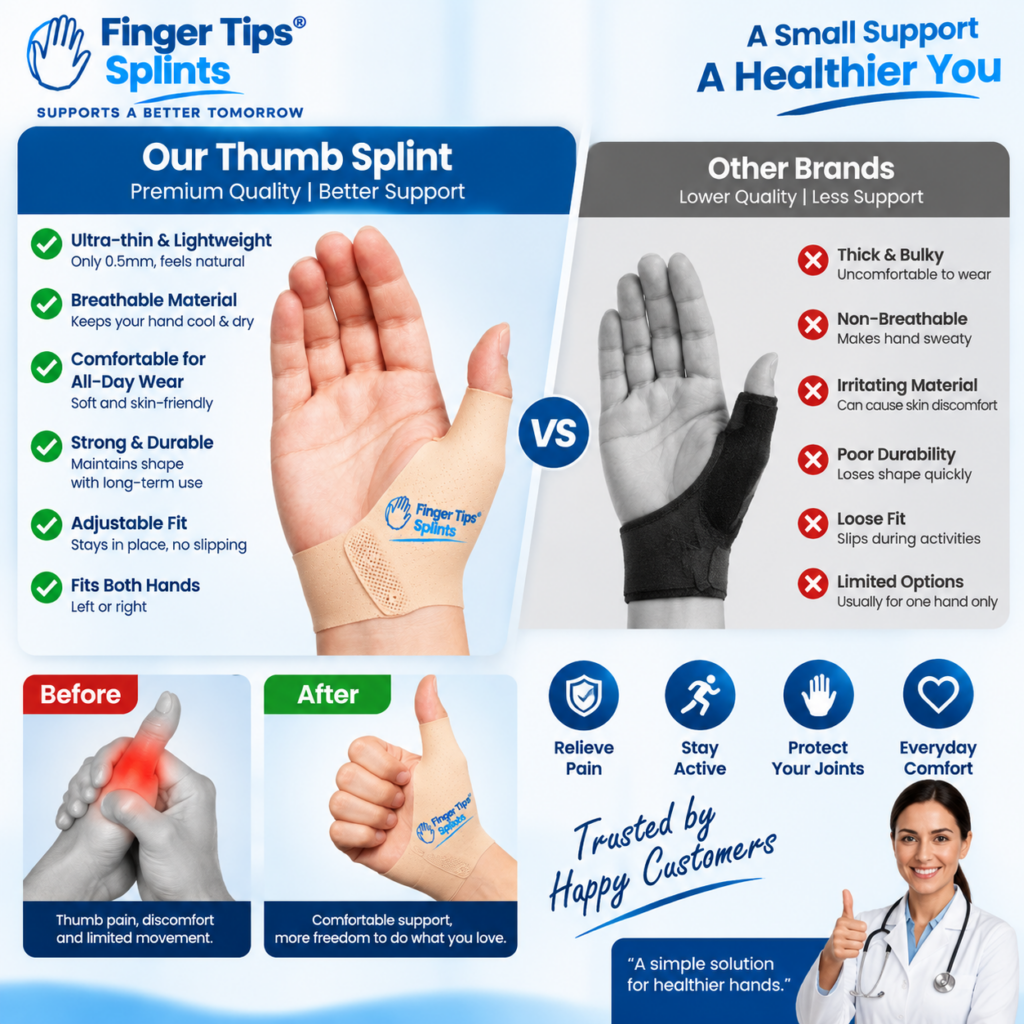
Product Spotlight: FingerTipSplint Thumb Support Sleeve Splint
After understanding the different support design categories, here is a specific product to examine. The Thumb Support Sleeve Splint is one example of a sleeve-style thumb support design. It represents the sleeve-style design category discussed in this article.
Thumb Support Sleeve Splint
- Sleeve-style construction designed around the thumb
- Flexible support characteristics
- Thumb-focused coverage and positioning
- Full product specifications available on the product page
Evaluating the Product Using the Design Framework
Construction
Review the sleeve-style construction on the product page. Check how the design is structured around the thumb.
Coverage
Review which areas the product covers. Confirm the coverage matches your intended purpose.
Flexible Support
Review the material and flexibility characteristics described. Check the product specifications for details.
Fit
Review the sizing and fit information provided. Compare your measurements against any stated range.
Everyday Use
Consider how the design may fit routine activities based on its documented characteristics. Review the care instructions and intended use information.
For the focused pre-purchase checklist, the reference What to Look for When Choosing a Thumb Support Sleeve Splint covers the selection process. For a direct sleeve vs traditional splint comparison, see Thumb Support Sleeve vs Traditional Splint: What’s the Difference?.
Common Buyer Mistakes
These mistakes come up frequently when comparing thumb support designs. Avoiding them improves the selection process.
Braces vary widely in construction. The term alone doesn’t tell you what the product does.
Check: the specific product’s construction and specifications.
Sleeve-style products differ in material, coverage, and construction.
Check: the specific product’s documented characteristics.
Some braces are soft and flexible; others are more structured.
Check: the construction and materials described.
Coverage determines which area interacts with the product.
Check: the coverage dimensions in the listing.
A design that restricts movement you need may not be suitable.
Check: how the product behaves during your typical activities.
Correct size is the foundation of good fit.
Check: measure and compare to the manufacturer’s sizing chart.
Tightness is not a measure of support.
Check: adjust for appropriate fit, not maximum pressure.
How the product stays in place affects its practicality.
Check: the fastening mechanism and its ease of use.
The manufacturer’s intended use should match what you need.
Check: the product’s stated purpose.
Labels describe design characteristics, not medical conditions.
Check: whether professional assessment is appropriate.
How to Read a Thumb Support Product Description
Product descriptions use specific words that can be interpreted in different ways. Translating them into specific questions helps buyers evaluate products more accurately.
| Term | What to Check |
|---|---|
| “Flexible” | What material and construction make it flexible? |
| “Adjustable” | What adjustment mechanism is actually present? |
| “Compression” | What area receives compression and how is it described? |
| “Support” | What actual structural features provide the support? |
| “Universal” | Are there multiple sizes, or an actual sizing guide? |
| “Ergonomic” | What specific design features are described? |
Buyer habit: Look for specific product information. Listings that provide measurements and construction details are easier to evaluate than listings that rely on general terms.
When Design Alone Isn’t Enough
Design characteristics are important for product selection, but they cannot determine medical appropriateness. Readers shouldn’t try to determine the appropriate support solely from whether something is called a sleeve or brace.
Seek appropriate professional evaluation for: significant injury, visible deformity, severe or worsening pain, major swelling, persistent numbness or tingling, substantial movement loss, or symptoms that aren’t improving.
Also, some situations may require a specific form of immobilization or treatment that a flexible sleeve may not provide. If a healthcare professional has recommended a specific type of support, follow that guidance.
Quick Decision Framework
This six-step framework helps organize the decision when comparing thumb support designs.
Frequently Asked Questions
A thumb sleeve generally uses fabric or sleeve-style construction that wraps around the thumb and hand area. A thumb brace is a broader category that may include straps, adjustable closures, reinforcement, or structured components. The terms overlap in product marketing, and terminology isn’t standardized. Construction, coverage, support, movement, and fit matter more than the label alone.
Not necessarily. A sleeve is a type of construction — a flexible material that wraps around the thumb. A splint generally describes a device intended to support, stabilize, position, or limit movement. Some sleeve-style products function as support products; some splints are more structured. The construction matters more than the label.
No. “Brace” describes a category, not a single rigidity level. Some braces are soft and flexible; others are semi-structured; others include rigid components. The actual rigidity depends on the specific product’s construction and materials.
This depends on the specific construction. Sleeve-style designs are often more flexible, but brace-style designs vary widely — some are flexible and some are more structured. Movement characteristics depend on the product’s material, thickness, coverage, and structure, not on the category name alone.
Suitability depends on the specific product’s design, fit, and the activity. A sleeve with appropriate coverage, comfortable material, secure fit, and enough movement for the activity is more likely to be suitable. Match the product to the activity you do most and check its behavior during that activity before relying on it for extended use.
Check the construction, coverage, movement characteristics, adjustability, fit, comfort features, and intended use. Look for specific product specifications rather than relying on category labels. The right choice depends on your specific requirements and the manufacturer’s stated design characteristics.
Seek professional advice for significant injury, visible deformity, severe or worsening pain, major swelling, persistent numbness or tingling, substantial movement loss, symptoms that aren’t improving, or uncertainty about whether immobilization is needed. A consumer thumb support product is not a substitute for professional medical assessment or prescribed medical support.
Understand the Design Behind the Label
Don’t choose a thumb support based on whether the label says “sleeve,” “brace,” or “splint.” Understand the actual construction, coverage, movement, adjustability, fit, and intended use behind the label. Design → Coverage → Support → Movement → Adjustability → Fit → Activity → Choice
The Bottom Line on Thumb Sleeve vs Brace
The difference between a thumb sleeve and a thumb brace comes down to construction and design characteristics, not to the label alone. A sleeve generally uses sleeve-style construction with flexible material. A brace is a broader category that may include straps, structure, or reinforcement. Neither is universally better — the right choice depends on the intended purpose and required level of support.
The framework in this guide — Design → Coverage → Support → Movement → Adjustability → Fit → Activity → Choice — helps buyers evaluate specific products more effectively. Understanding the design behind the label produces better outcomes than choosing by appearance or marketing language.
If you want to continue exploring within this cluster, the flexible design reference Flexible Thumb Support Splint: What Should Buyers Know? covers flexibility in more detail, and the fit guide Thumb Sleeve Splint Fit Guide: Understanding Coverage and Comfort covers fit. For a wider reference, explore the full FingerTipSplint blog library.
This article is for general information only and is not a substitute for professional medical advice. Always consult a qualified healthcare provider for diagnosis and treatment of any medical condition.