
Finger Support Products Explained: Where Do Sleeves Fit In?
Searching for finger support can feel overwhelming. You’ll encounter sleeves, splints, braces, wraps, guards, joint supports, buddy supports, and other structured devices. What’s actually different between them? This guide maps the entire finger-support product landscape — explaining what each category is designed around and, most importantly, where a finger sleeve fits within it.
What This Guide Covers
- Quick Answer
- What Counts as Finger Support?
- Main Product Types
- 3D Product Map
- Finger Sleeves
- Finger Wraps
- Finger Braces
- Finger Splints
- Finger Guards
- Joint Supports
- Buddy Support
- Where Does a Sleeve Fit?
- 3D Support Spectrum
- Sleeve vs Wrap vs Brace vs Splint
- Choose by Design Priority
- Find the Product Category
- Activity-Based Comparison
- Fit Across Product Types
- Common Misunderstandings
- How to Read a Product Page
- Product Spotlight
- When a Sleeve Isn’t the Right Category
- FAQ
Quick Answer: Where Do Finger Sleeves Fit Among Finger Support Products?
Finger sleeves generally occupy the flexible, low-profile end of the finger-support product landscape, emphasizing coverage, fit, comfort and mobility depending on design. Other support products may use wraps, adjustable structures or rigid/semi-rigid components to provide different levels of stabilization or movement control.
That’s the central takeaway. If you want to understand the wider landscape of finger support products before choosing something specific, this guide walks through each category. For the sleeve-specific deep dive, see Finger Sleeves for Finger Support: What Are They and How Do They Work?
What Counts as a Finger Support Product?
“Finger support product” is an umbrella term covering a wide range of products designed around different priorities. These products aren’t medically equivalent, and they aren’t designed for the same purpose. Here are the main design priorities you’ll encounter:
🎯 Coverage
🔄 Compression
☁️ Comfort
🛡️ Protection
🏗️ Stabilization
🎯 Positioning
🚫 Movement control
Important: A finger support product is not automatically a medical treatment. These products are designed around different combinations of coverage, comfort, support, or structural stability — not every product is intended for the same purpose.
The Main Types of Finger Support Products
Here’s the big picture. Each product type is built around a different design philosophy, and each serves a different purpose.
| Product Type | Typical Design | Movement | Adjustability | Main Design Focus |
|---|---|---|---|---|
| 🧵 Finger Sleeve | Flexible sleeve | Usually relatively high | Product-dependent | Coverage / comfort / usability |
| 🌀 Finger Wrap | Wraparound material | Variable | Often adjustable | Fit / compression / coverage |
| 🩹 Finger Brace | Structured or semi-structured | Variable | Often adjustable | Support / stability |
| 🦴 Finger Splint | Structured/rigid components | Often more restricted | Product-dependent | Positioning / movement control |
| 🛡️ Finger Guard | Protective covering | Variable | Product-dependent | Protection |
| 🎯 Joint Support | Focus around a joint | Variable | Product-dependent | Joint-area support |
| 👥 Buddy Support | Two fingers together | More restricted between paired fingers | Product-dependent | Stabilization |
Note: Product categories can overlap, and exact characteristics depend on the specific design. A “brace” from one manufacturer may function similarly to a “sleeve” from another. Always check the actual product specifications.
Interactive 3D: Finger Support Product Map
Tap each product type to see how it differs
SLEEVE
Flexible / low-profile
WRAP
Adjustable / wraparound
BRACE
Structured / adjustable
SPLINT
Structured / movement control
GUARD
Protection-focused
JOINT SUPPORT
Joint-area focus
BUDDY SUPPORT
Paired-finger support
Finger Sleeve
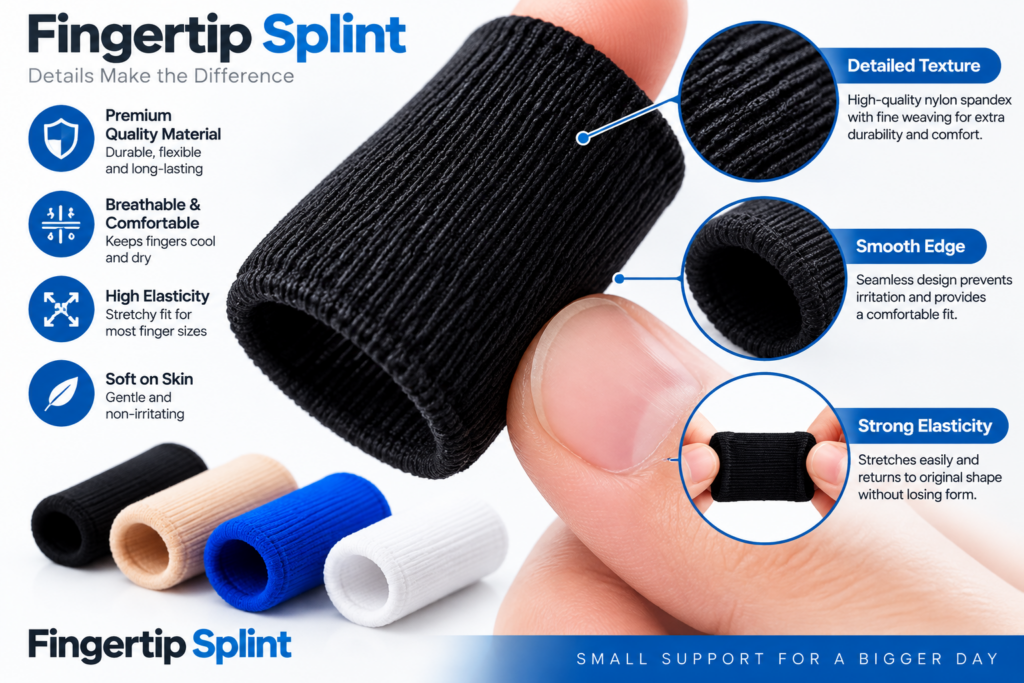
A flexible, sleeve-style product that fits around part or all of a finger. Designed around coverage, comfort, and everyday usability. Typically allows natural finger movement and offers a low profile compared to more structured products.
Product categories can overlap, and exact characteristics depend on the specific design.
Finger Sleeves Explained
Now let’s zoom in on the specific product we’re focused on. A finger sleeve is a flexible, sleeve-style product designed to fit around part or all of a finger. Its defining characteristics:
Common Design Characteristics
- Flexible material construction
- Sleeve-style (not wrap or strap-based)
- Low-profile design
- Finger coverage that varies by product
- Stretch and elasticity depending on design
Main Consideration
How does the sleeve balance support, coverage, comfort, and movement? The answer depends on the specific product’s design and construction.
For the full feature and design breakdown, see Finger Support Sleeves Explained: Features, Uses and Design.
Finger Wraps Explained
A finger wrap is built differently from a sleeve. Instead of sliding on as a pre-shaped covering, a wrap is designed to wrap around the finger — often with overlapping material or adjustable tension.
Common Characteristics
- Wraparound construction
- Adjustable tension depending on design
- Overlapping material layers
- Variable coverage based on how it’s applied
Main Distinction
A wrap may allow more adjustability, while a sleeve generally relies more on its predefined size and material stretch. This isn’t true for every product, but it’s the general design difference.
Finger Braces Explained
“Brace” is a broad term that can describe products ranging from relatively soft supports to more structured designs. This is why the name alone doesn’t tell you everything about a product’s performance.
Potential Features
- Straps or closures
- Reinforced sections
- Structured support zones
- Adjustable fit systems
- Joint-focused designs
Main Question
Does the user need a more structured design than a simple sleeve provides? The answer determines whether a brace category is worth investigating.
Finger Splints Explained
A finger splint is designed around structure rather than flexibility. Its purpose is typically to stabilize, position, or limit movement of a specific part of the finger.
Common Design Elements
- Rigid or semi-rigid components
- Shaped support structures
- Straps or fastening mechanisms
- Specific positioning features
Design Focus
- Stabilization
- Positioning
- Movement control
- Consistent restriction
For the detailed comparison between these two categories, see Finger Support Sleeve vs Finger Splint: What’s the Difference?
Finger Guards Explained
A finger guard is designed around protection from a specific environmental or mechanical risk. This is a fundamentally different design goal from support, coverage, or stabilization.
Important safety point: An ordinary finger sleeve should not automatically be treated as a protective guard against heat, sharp objects, chemicals, or other workplace hazards unless the manufacturer specifically rates it for that purpose. If protection is your priority, look for equipment designed for the specific hazard.
Joint Supports Explained
Some products focus on a particular joint rather than the entire finger. The key difference is where the product concentrates its support.
Common Characteristics
- Joint-focused coverage
- Flexibility that varies by design
- Often adjustable
- Movement characteristics depend on the specific joint area
- Profile varies by product
Main Distinction
Where the support is concentrated. A joint support focuses on a specific movement area; a sleeve typically covers a broader section of the finger.
Buddy Support Explained
Buddy support involves pairing one finger with an adjacent finger to share positioning and reduce independent movement. This is a fundamentally different approach from a sleeve or a splint.
Common Characteristics
- Two-finger configuration
- Shared positioning between fingers
- Reduced independent movement
- Different design objective from a single-finger product
Design Focus
Stabilization through pairing. This approach often requires professional guidance to determine whether it’s appropriate for a specific situation.
Where Does a Finger Sleeve Fit?
This is the central question of the article. Finger sleeves generally emphasize flexible coverage and everyday usability, positioning them at the flexible end of the support spectrum.
Sleeves Generally Emphasize
- Flexible coverage
- Low profile
- Ease of everyday use
- Preserved finger movement
- Comfort
- Simple sleeve construction
Other Products May Emphasize
- Adjustability
- Structural reinforcement
- Stabilization
- Positioning
- Movement restriction
- Protection
Interactive 3D: Support Spectrum
Tap each position to see how it differs
Finger Sleeve
Flexible, low-profile design. Prioritizes coverage, comfort, and everyday usability while preserving natural finger movement. Suited for daily activities where flexibility remains important.
This is a conceptual design framework, not a standardized medical classification. Actual products vary significantly within each category.
Sleeve vs Wrap vs Brace vs Splint
Here’s a practical comparison of the four most commonly confused categories:
| Consideration | Sleeve | Wrap | Brace | Splint |
|---|---|---|---|---|
| Construction | Sleeve | Wraparound | Soft/structured | Structured |
| Flexibility | Often higher | Variable | Variable | Often lower |
| Adjustability | Product-dependent | Often higher | Often higher | Product-dependent |
| Bulk | Often lower | Variable | Variable | Can be higher |
| Movement control | Usually limited | Variable | Variable | Often greater |
| Everyday usability | Design-dependent | Design-dependent | Design-dependent | Design-dependent |
No single option is universally “best.” The appropriate choice depends on what you need the support to accomplish.
Choose by Design Priority, Not Product Name
Instead of asking “which finger support product is best?” — a question that has no single answer — ask “what do I actually need the support to do?” Here’s how different priorities point toward different categories:
🔄 Flexibility
Movement preserved
🎯 Coverage
Area covered
☁️ Comfort
Wear experience
⚙️ Adjustability
Customizable fit
🛡️ Protection
Hazard shielding
🏗️ Stabilization
Positioning support
🚫 Movement Control
Restriction
🔄 Flexibility Priority
If you prioritize flexibility and preserved movement, sleeve-style products are generally the most relevant category to investigate. Look for flexible construction, low profile, and coverage matched to your intended use.
Interactive: Find the Product Category
Select your main priority. This is educational category guidance, not a medical recommendation.
Select your priority above to see category guidance.
Activity-Based Comparison
How different support categories relate to everyday activities:
| Activity | What to Consider |
|---|---|
| ⌨️ Typing | Flexibility + low interference |
| ✍️ Writing | Movement + grip |
| 📱 Smartphone use | Mobility |
| 💼 Desk work | Flexibility + comfort |
| ✈️ Travel | Portability |
| 🎯 Stabilization-focused use | Structure may be more relevant |
| 🛡️ Hazardous work | Specifically rated protection required |
For a deeper activity-based guide, see Understanding Finger Support Sleeves for Everyday Activities.
How Fit Changes Across Product Types
Fitting isn’t identical across categories. Here’s how it differs:
🧵 Sleeve
Usually depends on sizing and material stretch.
🌀 Wrap
May allow adjustment through wrapping tension.
🩹 Brace
May use straps or adjustable sections.
🦴 Splint
May require more specific positioning.
For the full fit framework, see Finger Sleeves for Support: A Guide to Fit, Comfort and Coverage.
Common Misunderstandings
These six misconceptions cause a lot of confusion. Let’s correct them:
False. Support products can have very different designs, priorities, and purposes.
Not necessarily. A sleeve and a splint can have different design goals. One prioritizes flexibility; the other prioritizes structure.
Not universally. The appropriate design depends on the intended purpose. More structure often means less movement.
Only if the specific product is designed and rated for that hazard. Ordinary sleeves aren’t protective equipment.
Not automatically. Coverage is a design choice, and more coverage can add bulk and reduce movement.
Flexibility and structural stabilization are different design characteristics — not strength versus weakness.
How to Read a Finger Support Product Page
Product names don’t tell you everything. Here’s what to actually look for when evaluating any finger-support product:
Sleeve, wrap, brace, splint, guard, or other? This gives a starting point but not the full picture.
What is it made from? This affects feel, durability, stretch, and comfort.
How is sizing determined? Follow the specific manufacturer’s measurement instructions.
Which part of the finger does it cover? Match coverage to your intended use.
How much movement is expected? Check whether it suits your activity.
Are there rigid or semi-rigid components? This determines how much movement control the product provides.
What does the manufacturer actually say the product is designed for?
What limitations and care instructions are provided? These are important for safe and appropriate use.
Where a Finger Sleeve Product Fits
After understanding the wider landscape, here’s how a specific finger sleeve product fits within it. Rather than just saying “buy this,” here’s what to check on the FingertipSplint product page:
Finger Sleeves for Finger Support
- Flexible sleeve-style design
- Intended for everyday finger support
- Product specifications available on the product page
- Designed for finger coverage and comfort
- Available to explore with current product details
For the broader buying framework, see What to Consider When Choosing Finger Support Sleeves. For quality considerations, see What Makes a Good Finger Support Sleeve for Daily Use?
When a Sleeve May Not Be the Appropriate Category
A flexible sleeve should not automatically replace:
⚕️ A prescribed support device
🩺 Professional evaluation
🦴 A structured immobilization device
🛡️ Proper protective equipment
Consider professional evaluation when there is significant injury, visible deformity, severe or worsening pain, substantial swelling, persistent numbness or tingling, major movement loss, or symptoms that aren’t improving.
For trusted guidance, see the AAOS OrthoInfo hand and wrist conditions library, NHS guide on hand pain, and MedlinePlus hand injuries and disorders. Additional perspectives are available from Mayo Clinic, Cleveland Clinic, and Johns Hopkins Medicine. The NIH provides research-based information, and if a neurological component is involved, NINDS is the specialist resource. For regulatory context on medical devices, the FDA is authoritative, and for general public health information, the CDC is a trusted source.
Frequently Asked Questions
Finger support products is an umbrella term covering a wide range of products designed around different priorities including coverage, compression, comfort, protection, stabilization, positioning, and movement control. The category includes sleeves, wraps, braces, splints, guards, joint supports, and buddy supports. These products aren’t medically equivalent — each is designed around different priorities and use cases. Always check the specific product’s construction and intended use rather than relying on the category name.
A finger sleeve is a flexible, sleeve-style product that fits around part or all of a finger. Depending on its construction, it may provide coverage, light support, cushioning, or gentle compression while preserving natural finger movement. Sleeves generally prioritize flexibility, everyday usability, and comfort. They’re typically not designed for immobilization or rigid stabilization — that’s a different product category.
Finger sleeves are typically soft, flexible, and designed for coverage, light support, and everyday comfort with preserved finger movement. Finger splints are structured and often designed to stabilize, position, or restrict movement. They serve different purposes and aren’t interchangeable. If you specifically need movement restriction or stabilization, a splint is usually more appropriate. A sleeve is designed for flexibility, not restriction.
“Brace” is a broad term that can describe products ranging from relatively soft supports to more structured designs. A soft brace may function similarly to a sleeve, while a structured brace may provide more movement control. Braces often include straps or adjustable closures. The name alone doesn’t tell you everything — the actual construction and intended use matter more. Always check the specific product’s design.
A finger wrap is a product designed to wrap around the finger, often with overlapping material or adjustable tension. Wraps typically offer more adjustability than sleeves because the user can control how tightly they’re applied. However, correct application matters for wraps — they require proper technique to function well. A sleeve, by contrast, relies more on its predefined size and material stretch.
A finger guard is designed around protection from a specific environmental or mechanical risk. Unlike sleeves, which focus on coverage and comfort, guards focus on shielding the finger from hazards. Important: an ordinary finger sleeve should not be treated as a protective guard against heat, sharp objects, chemicals, or workplace hazards unless the manufacturer specifically rates it for that purpose.
Buddy support involves pairing one finger with an adjacent finger to share positioning and reduce independent movement. This is a fundamentally different approach from a sleeve or a splint — the support comes from the adjacent finger rather than from a covering or structure. This approach typically requires professional guidance to determine whether it’s appropriate for a specific situation.
Finger sleeves generally occupy the flexible, low-profile end of the finger-support product landscape. They prioritize flexibility, coverage, comfort, and everyday usability over rigid stabilization or movement restriction. In a conceptual spectrum, they sit between minimal coverage products and more structured supports, closer to the flexible end.
Yes — flexibility is the defining characteristic of most finger sleeves. They’re designed to allow natural finger movement while providing coverage, light support, or comfort. However, the actual degree of flexibility varies by product. Some sleeves are thinner and more stretchy; others have slightly more structure. Always check the specific product’s specifications rather than assuming based on the category name.
Generally, no — finger sleeves are designed to preserve natural finger movement. That’s their key difference from structured supports. If you specifically need movement restriction or stabilization, a sleeve may not be the right product. A more structured brace or splint might be more appropriate. Match the level of movement control to your actual need.
Yes — many people use finger sleeves during everyday activities like typing, writing, smartphone use, office work, and household tasks. Their flexibility and low-profile design make them practical for daily wear. However, different activities require different characteristics. Consider what movement the activity requires, what contact points are involved, and how long you’ll be wearing the sleeve during that activity.
Not exactly. Sleeves are typically slip-on, stretch-based products. Braces may include straps, closures, or structured components. Some soft braces function similarly to sleeves, while others are much more structured. The word “brace” doesn’t automatically mean more supportive than a sleeve — the actual construction and design matter more than the category label.
No. Finger sleeves are typically flexible and designed for coverage, comfort, and light support. Splints are structured and designed to stabilize, position, or restrict movement. They serve different purposes. A sleeve doesn’t substitute for a splint when stabilization is needed. If you’re unsure which type matches your situation, professional guidance is more valuable than product comparison alone.
Structured splints and rigid devices typically provide the most structure, followed by semi-rigid supports, braces, and then flexible sleeves and wraps. However, “more structure” isn’t automatically better — it depends on what you need. More structure usually means less movement. If flexibility is important for your activity, a sleeve or soft support may be more appropriate.
No. A general-purpose finger sleeve is a support product, not protective equipment. It isn’t designed to protect against sharp objects, heat, chemicals, heavy impact, or workplace hazards. If you need protection from a specific hazard, look for equipment specifically designed and rated for that purpose. Don’t confuse support with protection — they serve different functions.
Start by identifying what you need the support to accomplish. Then compare products based on construction, flexibility, adjustability, bulk, movement control, and intended use. Don’t rely on category names alone — the same category can include very different products. Read the actual specifications, follow the manufacturer’s sizing instructions, and match the product to your requirements rather than to a category label.
Understand the Landscape. Choose With Confidence.
From flexible sleeves to structured splints, each category serves a different purpose. The key is matching the product to your actual requirements — not to the most structured option or the one with the most features. Sleeve → Wrap → Brace → Splint → Guard → Joint → Buddy
The Bottom Line on Finger Support Products
Finger support isn’t one product — it’s a spectrum. Sleeves prioritize flexibility, coverage, and everyday usability. Wraps offer adjustability. Braces provide a middle ground between flexible and structured designs. Splints prioritize stabilization and movement control. Guards focus on protection. Joint supports concentrate on specific areas. Buddy supports use pairing for stabilization.
Understanding this landscape helps you evaluate any product more accurately. It also clarifies where a finger sleeve fits: at the flexible, low-profile end of the spectrum, designed for everyday coverage, comfort, and preserved movement.
For readers ready to evaluate a specific product using this framework, the Finger Sleeves for Finger Support product page is the natural next step. For deeper context on sleeves specifically, see Finger Support Sleeves Explained: Features, Uses and Design. For the sleeve vs splint comparison, see Finger Support Sleeve vs Finger Splint: What’s the Difference? Explore the full FingertipSplint blog library for more guides.
This article is for general information only and is not a substitute for professional medical advice. Always consult a qualified healthcare provider for diagnosis and treatment of any medical condition.