
Thumb Support Sleeve Splint: A Complete Buyer’s Guide
Before you buy, know what you’re buying. Many products are described as thumb sleeves, thumb braces, thumb supports, and thumb splints — but they can differ in construction, coverage, flexibility, adjustability, material, sizing, movement, and intended use. This complete buyer’s guide breaks down the characteristics worth checking before choosing a thumb support sleeve splint.
What This Complete Buyer’s Guide Covers
- Quick Answer
- Who Is This Guide For?
- First Question: Why Are You Buying One?
- Understand the Design Before the Product Name
- The 10-Point Buyer Checklist
- Interactive Buyer Checklist
- 3D Interactive: Anatomy of a Sleeve Splint
- How Much Flexibility Do You Need?
- Coverage: More Isn’t Automatically Better
- Fit and Sizing
- Material and Construction
- Comfort: What Should Buyers Actually Look For?
- Everyday Activity Compatibility
- Product Quality: What Separates a Good Listing From a Weak One?
- Price vs Value
- Product Spotlight
- How to Compare Two Thumb Sleeve Splints
- Common Buyer Mistakes
- When a Buyer Should Seek Professional Guidance
- 5-Minute Pre-Purchase Routine
- Interactive: Buyer Decision Map
- FAQ
- Conclusion
Quick Answer: What Should I Look for When Buying a Thumb Support Sleeve Splint?
When buying a thumb support sleeve splint, evaluate the intended purpose, construction, flexibility, coverage, sizing, fit, adjustability, comfort, activity compatibility, care requirements, and product information. Check the manufacturer’s specifications and fitting instructions rather than choosing solely from appearance, price, or the word “support” in the product name.
If you need the foundational definition of what a thumb support sleeve splint is, the reference Thumb Support Sleeve Splint: What Is It and How Does It Work? covers that ground. This buyer’s guide brings together the full purchase journey.
Who Is This Guide For?
This guide is designed for several types of buyers. Understanding which category you fall into helps you focus on the sections that matter most.
First-Time Buyers
People unfamiliar with thumb support products who need to understand what to look for and how to evaluate options.
Existing Users
People who already use a thumb support and want to try a different design or replace a worn product.
Everyday-Use Buyers
People who need a product compatible with routine activities such as typing, writing, phone use, and desk work.
Comparison Shoppers
People comparing two or more sleeve-style products and needing a systematic way to evaluate differences.
Caregivers and Parents
People looking for general product information to help someone else select a thumb support. This guide is not a substitute for professional assessment when there is a significant injury or concerning symptoms.
First Question: Why Are You Buying One?
Before discussing brands or features, identify your intended use. The purpose shapes every subsequent decision — coverage, support, sizing, and movement requirements all depend on it.
Everyday support
Activity-related support
Comfort during routine tasks
Temporary support
Protection and coverage
Movement considerations
Key question: What do you expect the product to help you do? Starting with intended use — rather than with products — produces better buying decisions.
Understand the Design Before the Product Name
Product names can overlap. Before evaluating specific products, understand the general categories so you can interpret listings more accurately.
Sleeve
Sleeve-style construction with flexible material that wraps around the thumb and hand area.
Brace
Broader category with varying designs. May include soft, semi-structured, or structured construction.
Splint
May incorporate more specific positioning or restriction features depending on construction.
For a detailed examination of the design differences, the reference Thumb Sleeve or Brace? Understanding Different Support Designs covers terminology and construction in more depth.
The 10-Point Buyer Checklist
This framework organizes the entire buying decision into ten evaluation points. Each is expanded in the sections that follow.
Interactive Buyer Checklist
Work through this checklist before purchasing. Tap each item to confirm it for the product you are considering.
Before You Buy Checklist
Tap each item as you confirm it.
Check items to see your readiness summary.
Anatomy of a Thumb Support Sleeve Splint: 3D Interactive
This interactive shows the key components to evaluate in a thumb support sleeve splint. Tap each component to see what to check.
Interactive 3D: Buyer-Ready Anatomy
Tap each component to see what to check
1. Thumb Coverage
Which part of the thumb is enclosed by the sleeve. Coverage is a physical property set by design and cannot be extended by adjustment. Match coverage to your intended purpose.
Design → Fit → Support → Movement → Comfort
How Much Flexibility Do You Need?
Flexible doesn’t automatically mean better. The right flexibility level depends on your intended use and the product’s design. Understanding what flexibility means helps you evaluate products more accurately.
Flexibility Spectrum
Conceptual spectrum — the right level depends on your needs
Questions to Ask
- What activities will you perform?
- How much thumb movement is needed?
- How much structure does the product provide?
- Is the product intended for that activity?
Important Note
The correct choice depends on the product’s intended use and individual circumstances. For deeper flexibility considerations, see the dedicated guide.
For a detailed look at flexibility-focused buying considerations, the reference Flexible Thumb Support Splint: What Should Buyers Know? covers the topic in depth.
Coverage: More Isn’t Automatically Better
Coverage determines which parts of the thumb and hand are enclosed by the product. Different designs cover different areas, and the appropriate coverage depends on the intended purpose.
Thumb-Focused Coverage
Focuses on the thumb itself. Lower-profile design considerations. May allow more hand movement.
Thumb + Hand Coverage
Extends to include part of the hand. Broader contact and support.
Thumb + Wrist Coverage
Potentially more extensive construction. May provide additional support but occupy more area.
Important: More coverage doesn’t automatically mean a better product. More coverage can also influence mobility, bulk, comfort, and ease of use. Match coverage to your purpose rather than maximizing it.
Fit and Sizing
Fit is one of the most important factors in a successful purchase. Size and fit are not the same thing — a correctly sized product can still fit poorly if positioned incorrectly or adjusted badly.
What Fit Involves
- Size: manufacturer’s sizing measurement
- Position: where the sleeve sits
- Coverage: whether the intended area is covered
- Pressure: appropriately secure without excessive tightness
- Movement: expected movements remain possible
- Comfort: seams, edges, and material cause no problems
Warning Signs
- Numbness or tingling
- Significant discoloration
- Persistent pain
- Persistent irritation
- Symptoms that worsen over time
Important: If use causes concerning numbness, tingling, significant discoloration, or persistent pain, discontinue use and seek appropriate advice. Do not simply tighten the sleeve further.
For a detailed fitting guide, the reference Thumb Sleeve Splint Fit Guide: Understanding Coverage and Comfort covers fit in depth.
Material and Construction
Material affects comfort, durability, and how the sleeve behaves during wear. But material alone does not determine performance — construction also matters.
Fabric composition
Elasticity
Thickness
Breathability
Seams and edges
Closures
Reinforcement
Moisture management
Cleaning requirements
Buyer lesson: Avoid vague claims such as “premium technology” unless the manufacturer actually explains what that means. Specific material and construction information is more useful than general descriptions.
Comfort: What Should Buyers Actually Look For?
Comfort is not simply about soft material. It is the result of multiple design and fit factors working together. Breaking comfort into specific elements helps evaluate products more objectively.
This sequence explains why comfort varies between products: each element in the chain contributes to the overall experience. A product that performs well on most elements but poorly on one may still feel uncomfortable.
Everyday Activity Compatibility
Different activities place different demands on a thumb support sleeve splint. This table helps evaluate compatibility based on your routine.
| Activity | What to Check |
|---|---|
| Writing | Thumb mobility and grip compatibility |
| Typing | Profile and comfort over extended sessions |
| Smartphone use | Thumb movement and touchscreen interaction |
| Reading | Grip comfort during holding |
| Desk work | Pressure and mobility through the workday |
| Travel | Convenience, portability, and adjustability |
| Light household tasks | Secure fit and movement during handling |
| Physical activities | Intended-use suitability and product limitations |
For a detailed look at how sleeve-style designs fit into daily activities, the reference How a Sleeve-Style Thumb Splint Fits Into Everyday Activities covers this topic in more depth.
Product Quality: What Separates a Good Listing From a Weak One?
A product listing is the primary evidence you have when buying online. A strong listing provides enough information to evaluate the product against your requirements. A weak listing leaves gaps that only become clear after purchase.
Look For
- Clear product photos (multiple angles)
- Sizing information
- Material details
- Fitting instructions
- Care instructions
- Clear product description
- Manufacturer information
- Realistic product claims
Be Cautious With
- Vague “medical grade” claims
- Unexplained technology
- Universal promises
- Unsupported treatment claims
- Unclear sizing
- No care instructions
- Exaggerated “best” claims
Price vs Value
Price is one factor among many. It doesn’t automatically determine quality, fit, or suitability for your needs. Buyers should compare products by characteristics rather than by price alone.
Material quality
Construction
Adjustability
Sizing information
Durability indicators
Care requirements
Intended use match
Customer support
Return policy
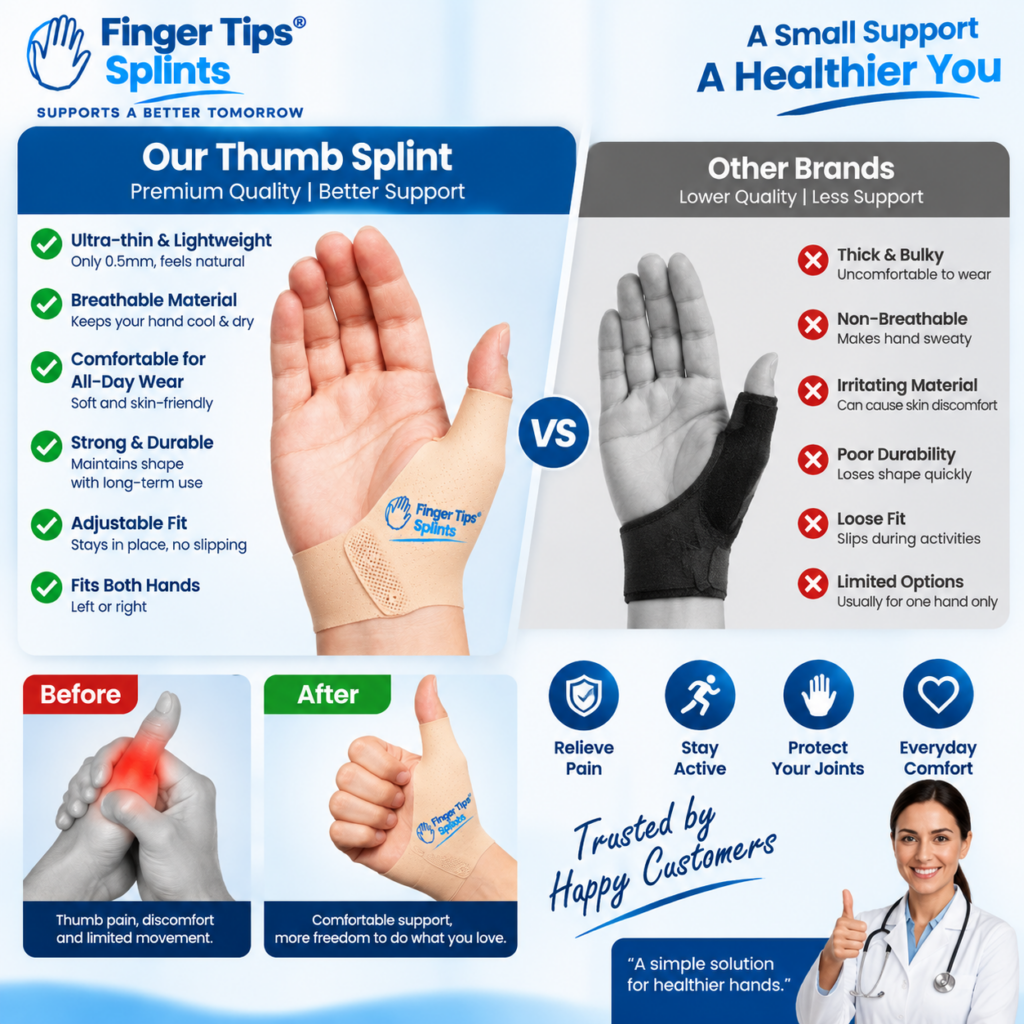
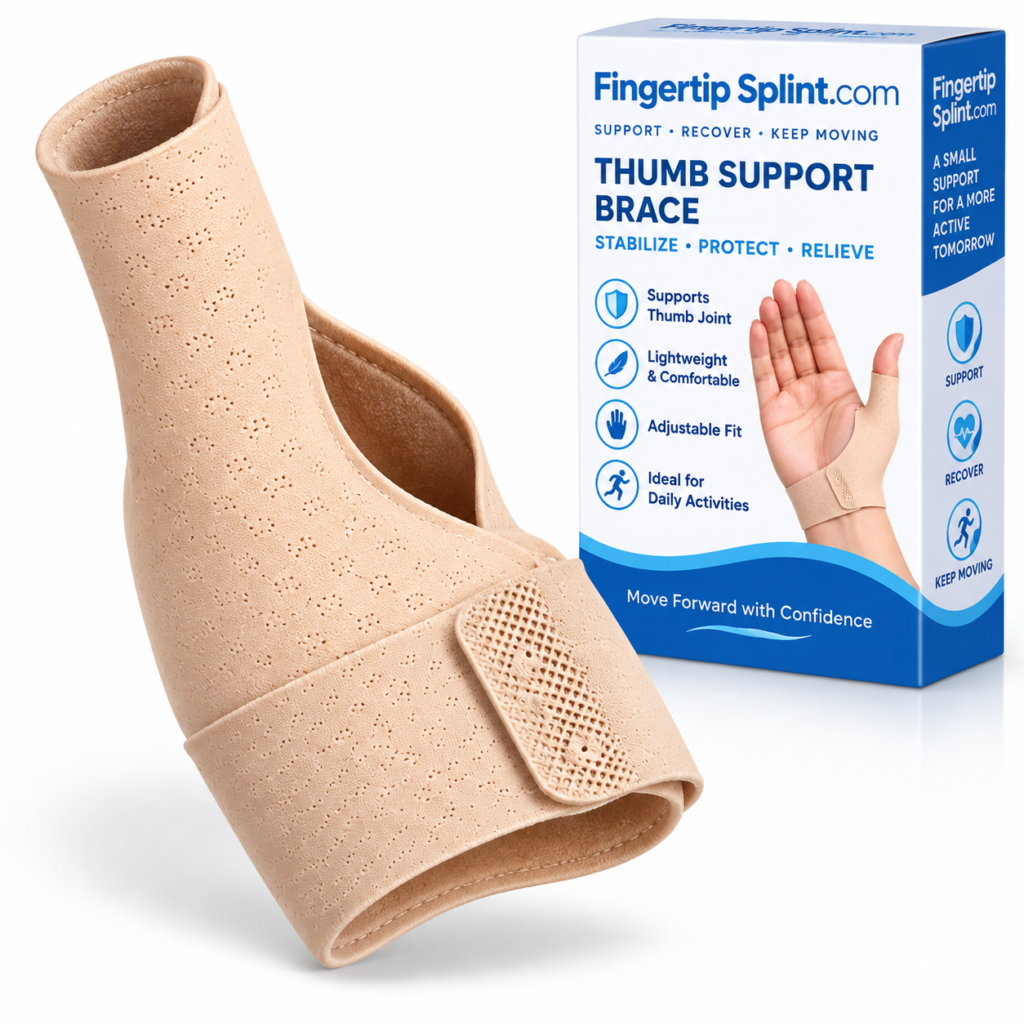
Product Spotlight: FingerTipSplint Thumb Support Sleeve Splint
For readers considering a sleeve-style design, the Thumb Support Sleeve Splint is an example worth examining against the checklist above. It represents the sleeve-style design category discussed in this guide.
Thumb Support Sleeve Splint
- Sleeve-style construction designed around the thumb
- Flexible support characteristics
- Thumb-focused coverage and positioning
- Full product specifications available on the product page
Evaluating the Product Using the Buyer Checklist
Intended Purpose and Design
Review the sleeve-style construction shown on the product page. Check how the design is structured around the thumb and what coverage it provides.
Coverage and Fit
Review which areas the product covers. Check the sizing information and compare your measurements against any stated range.
Flexibility and Material
Review the material and flexibility characteristics described. Check the product specifications for details about the material and its characteristics.
Adjustability
Review how the product is secured, if applicable. Check the adjustment mechanism and how it works.
Everyday Usability
Consider how the design may fit routine activities based on its documented characteristics. Review the care instructions.
Product Information Quality
Review the listing for clear sizing, material, adjustment, and care information. Prioritize listings that provide specific details.
For the focused pre-purchase checklist, the reference What to Look for When Choosing a Thumb Support Sleeve Splint covers the selection process step by step. For a direct design comparison, see Thumb Support Sleeve vs Traditional Splint: What’s the Difference?.
How to Compare Two Thumb Sleeve Splints
Suppose two products both claim to be flexible. Comparing them against a consistent framework helps identify differences that matter for your intended use.
| Factor | Product A | Product B |
|---|---|---|
| Material | Check specifications | Check specifications |
| Size options | Check sizing chart | Check sizing chart |
| Coverage | Check dimensions | Check dimensions |
| Flexibility | Check material and design | Check material and design |
| Adjustability | Check mechanism | Check mechanism |
| Care | Check instructions | Check instructions |
| Intended use | Check description | Check description |
| Product information | Check transparency | Check transparency |
Buyer principle: Don’t compare price first. Compare characteristics first. Price is one factor among many — it doesn’t tell you about fit, construction, or suitability for your needs.
Common Buyer Mistakes
These mistakes come up frequently when buying thumb support sleeve splints. Avoiding them improves the likelihood of a successful purchase.
Price does not tell you about fit, construction, or durability.
Check: compare features against your requirements.
Correct size is the foundation of good fit.
Check: measure and compare to the manufacturer’s sizing chart.
Flexibility and support are different characteristics.
Check: the product’s design and documented support characteristics.
Tightness is not a measure of support and can cause concerning symptoms.
Check: adjust for appropriate fit, not maximum pressure.
Coverage determines which part of the finger receives support.
Check: coverage dimensions against your intended area.
A design that restricts movement you need may not be suitable.
Check: how the product behaves during your intended activity.
Product photos don’t show how the product behaves.
Check: specifications and construction details.
Care requirements affect long-term practicality.
Check: whether care instructions are provided and practical.
Marketing language describes product characteristics, not medical outcomes.
Check: what the product is actually designed to do.
Different products have different designs and intended uses.
Check: whether the product’s design matches your specific needs.
When a Buyer Should Seek Professional Guidance
A product buying guide cannot determine whether a sleeve is appropriate for a specific injury or condition. Some situations require professional assessment rather than product selection.
Seek appropriate professional evaluation for: significant injury, visible deformity, severe or worsening pain, substantial swelling, persistent numbness or tingling, major movement loss, or symptoms that persist or worsen.
Also note that a flexible sleeve may not provide the same positioning or restriction as a more structured device. If a specific type of support has been recommended, follow that guidance.
For authoritative general information about thumb, hand, and wrist conditions, the following resources provide evidence-based content:
- Mayo Clinic for condition overviews and patient education.
- WebMD for general thumb and hand concern overviews.
- Healthline for practical wellness information.
- AAOS OrthoInfo for orthopedic guidance from specialists.
- NHS guide on hand pain for UK-based clinical guidance.
- MedlinePlus hand injuries and disorders for a broad reference library.
- Cleveland Clinic for clear patient-oriented explanations.
- Johns Hopkins Medicine for clinical and research-based perspectives.
- FDA for regulatory context on medical devices.
- NIH for research-based health information.
These resources provide general information and do not replace individualized advice from a qualified healthcare professional.
5-Minute Pre-Purchase Routine
This routine compresses the entire buyer’s guide into five minutes of practical steps. Each step has a specific purpose.
Minute 1
Define intended use. What do you want the product to help you do?
Minute 2
Check coverage. What areas does the product cover? Does that match your needs?
Minute 3
Read sizing information. Does the manufacturer provide clear measurements? Does your measurement fall within the range?
Minute 4
Review flexibility, material, and adjustability. Does the product’s design match your activity requirements?
Minute 5
Check care, limitations, and manufacturer instructions. Is the product practical to maintain? Are the intended use and limitations clearly described?
Interactive: Buyer Decision Map
Select the characteristic that matters most to you to see what to investigate. This is an information tool, not a medical recommendation engine.
Buyer Decision Map
Tap each priority to see what to investigate
Flexibility
Movement characteristics
Fit
Sizing and coverage
Comfort
Material, seams, pressure
Adjustability
Fastening system
Everyday Use
Activity compatibility
Support
Actual construction
Flexibility
Investigate movement characteristics. Check the material, thickness, and construction of the product. Consider how much thumb movement the activity requires and whether the design accommodates it. For deeper flexibility considerations, see the dedicated guide.
Frequently Asked Questions
Evaluate the intended purpose, construction, flexibility, coverage, sizing, fit, adjustability, comfort, activity compatibility, care requirements, and product information. Check the manufacturer’s specifications and fitting instructions rather than choosing solely from appearance, price, or the word “support” in the product name.
Use the manufacturer’s size chart and measurement instructions rather than guessing from S/M/L labels. Different manufacturers may use different sizing systems. If your measurement is borderline between sizes, check the adjustment range to see whether it accommodates your measurement. If the sizing chart is unclear, contact the seller before purchasing.
No. It should fit securely but not tightly. A secure fit stays in position during intended movement without creating excessive pressure or discomfort. Tightness is not a measure of support. If you experience numbness, tingling, significant discoloration, or persistent pain, remove the sleeve and reassess. Adjust for appropriate fit, not maximum pressure.
Neither is universally better. The appropriate design depends on your intended purpose and required movement control. Flexible sleeve-style designs may allow more natural thumb movement and may be more practical for everyday activities. More structured designs may provide more deliberate movement control. The right choice depends on what the product needs to do and, when relevant, professional guidance.
Compatibility depends on the design and the specific activity. A sleeve with appropriate coverage, comfortable material, secure fit, and enough movement for the activity is more likely to be suitable. Match the product to the activity you do most and check its behavior during that activity before relying on it for extended use.
Compare them against a consistent framework: material, size options, coverage, flexibility, adjustability, care requirements, intended use, and product information quality. Don’t compare price first — compare characteristics first. The right choice depends on how well the product’s characteristics match your requirements.
Seek professional advice for significant injury, visible deformity, severe or worsening pain, major swelling, persistent numbness or tingling, substantial movement loss, symptoms that aren’t improving, or uncertainty about whether immobilization is needed. A consumer thumb support product is not a substitute for professional medical assessment or prescribed medical support.
Know What You’re Buying Before You Buy It
A complete buyer’s decision comes down to matching the product’s actual design characteristics to your intended use. Evaluate purpose, design, flexibility, coverage, fit, comfort, adjustability, activity compatibility, quality, and product information before purchasing. Purpose → Design → Support → Flexibility → Coverage → Fit → Comfort → Activity → Quality → Care → Purchase
The Bottom Line on Buying a Thumb Support Sleeve Splint
A complete buyer’s guide doesn’t tell you which thumb support to buy. It teaches you how to evaluate purpose, design, flexibility, coverage, fit, comfort, adjustability, activity compatibility, quality, and product information before making a purchase. Applying this framework produces better outcomes than choosing by appearance or marketing language alone.
The framework in this guide — Purpose → Design → Support → Flexibility → Coverage → Fit → Comfort → Activity → Quality → Care → Purchase — works across products and listings. Starting with intended purpose and systematically evaluating each characteristic helps you make a confident, informed selection.
If you want to continue exploring within this cluster, the design terminology reference Thumb Sleeve or Brace? Understanding Different Support Designs covers how design families differ, and the everyday-use reference How a Sleeve-Style Thumb Splint Fits Into Everyday Activities covers real-world usability. For a wider reference, explore the full FingerTipSplint blog library.
This article is for general information only and is not a substitute for professional medical advice. Always consult a qualified healthcare provider for diagnosis and treatment of any medical condition.